A clear path from outdoor passion to environmental impact

Before she ever learned the language of watersheds, Andrea Lubberts ‘98 learned to love the outdoors by building forts, damming creeks, and following curiosity wherever it led.
“Awe, joy, and wonder were baked into my childhood,” said Lubberts.
Curiosity takes root
While she spent a lot of time outdoors, her passion really took root during an Earth month trivia contest her freshman year of high school. Students were encouraged to submit trivia questions for the contest, and Lubberts went all in submitting 75-percent of the questions used.
Needless to say, she “rocked the trivia contest” that she had apparently curated.
That moment served to propel her environmental curiosity further and her time at Calvin University as a student would root that passion deeper.
Finding direction at Calvin
Though she arrived at Calvin to study film and media, it was outside the classroom where her story really took shape. She found mentors and hands-on experiences that helped her connect story, science, and stewardship. She added an outdoor recreation major and spent summers leading backpacking trips and serving as an interpretive ranger in Olympic National Park. These experiences deepened her love for the outdoors and revealed a calling that would eventually bring together her passion for people, story, and the natural world.
When wonder meets responsibility
After graduating from Calvin, Lubberts and her husband worked at a camp in California, where she was responsible for outdoor education. While she was enjoying spending time in creation, she was also keenly aware that the health of the places she loved was not guaranteed. The land and waterways were being shaped – often negatively – by human activity. She began to feel the tension between the places she loved and the reality that they were being degraded.
The consequences extended beyond the landscape itself. What was at risk was not only the health of those places, but the well-being of the communities and ecosystems that depended on them.
A couple of years later, when Lubberts moved back to Michigan and started raising a family, her concerns for the natural world remained. She raised environmental-related concerns with her church asking them to reduce the amount of Styrofoam they used and printing they did. Lubberts was therefore on the top of church leaders’ minds when they received a letter from the Plaster Creek Stewards (PCS) asking if their church wanted to partner on creek restoration work.
Lubberts jumped at the opportunity.
Over the next five years, while raising her family, she’d volunteer alongside leaders from Calvin University’s Plaster Creek Stewards. And, in 2020, after years of faithfully serving as a volunteer, then part-time Program Assistant (2014-2020), she would be offered the job as the organization’s program manager.
From volunteer to career
Her work with PCS over the past six years has kindled her childlike wonder.
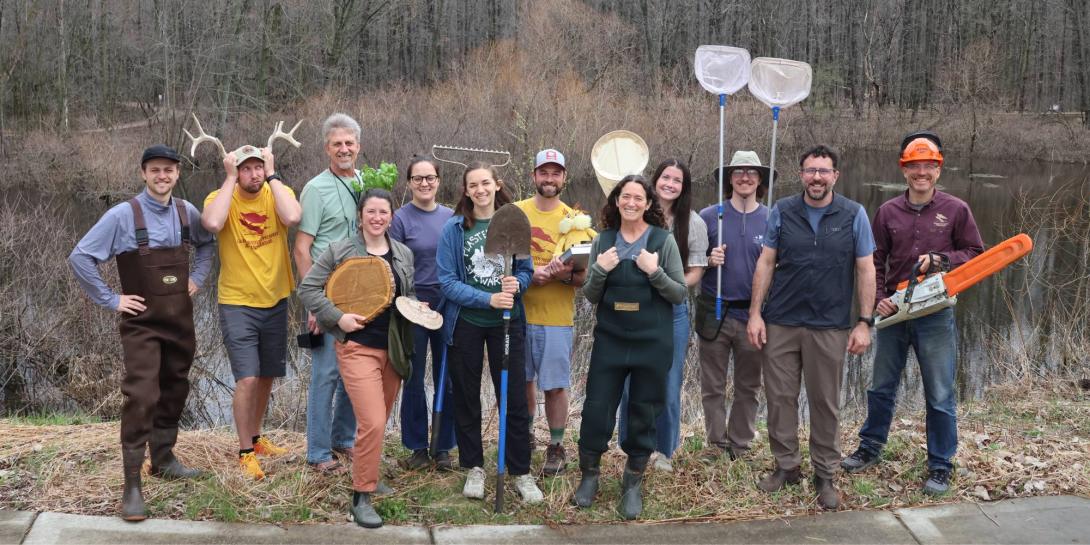
“What lights me up is when I get to go out in the creek and find things,” said Lubberts, who recalls discovering mussels for the first time, “to learn the names of mussels and to know they are in Plaster Creek.”
And the more she learns and discovers, the greater responsibility she feels.
Restoring rivers and relationships
“Taking responsibility and learning about the human impacts is the more serious “college-level” work, and we are called to take that next step,” said Lubberts. “We learn about our impact, how simply living here impacts the aquatics and the land, and we are called to do better. We learn how to live gently. That opens up all new sorts of joy and wonder.”
Lubberts says it’s about coming in with a posture of listening.
“We start building relationships with indigenous leaders and we learn from them how they lived here for thousands of years without causing the damage we’ve been doing in the past 150 years,” said Lubberts.
She says that understanding how they live provides a source of hope and joy that there are ways forward.
Receiving national recognition
While the work ahead can be daunting, Lubberts and the Plaster Creek Stewards team has made a lot of progress. In fact, this past month, Lubberts was honored with a national award, the River Network’s River Hero Award, which recognizes and showcases the achievements of individuals and teams who have advanced the movement toward a future of healthy, resilient rivers; safe, affordable drinking water; and climate-resilient communities. While she was one of two individuals to receive the honor, she sees it not as a personal achievement, but as a reflection of a much larger effort – a community committed to the flourishing of its place and people.
“This award reflects a community effort, and it was humbling that my name was on it,” said Lubberts. “There are a lot of community members that could have and rightfully should have been on the award.”
A community-wide effort
The real measure of success in Lubberts’ eyes is seeing the city come together and to see the relationships that have been built and the reconciliation that’s taken place between communities of people and people and nature.
“It’s really exciting to see people reconnecting,” said Lubberts. “There are so many groups in and around the city that now care about Plaster Creek. That’s really joyful work and it feels sustainable when people look to us, but they don’t rely on us.
“It doesn't feel heroic,” said Lubberts. “It feels like taking the next step.”


