Class project sharpens soft skills and creates sustainable path for the city of Grand Rapids
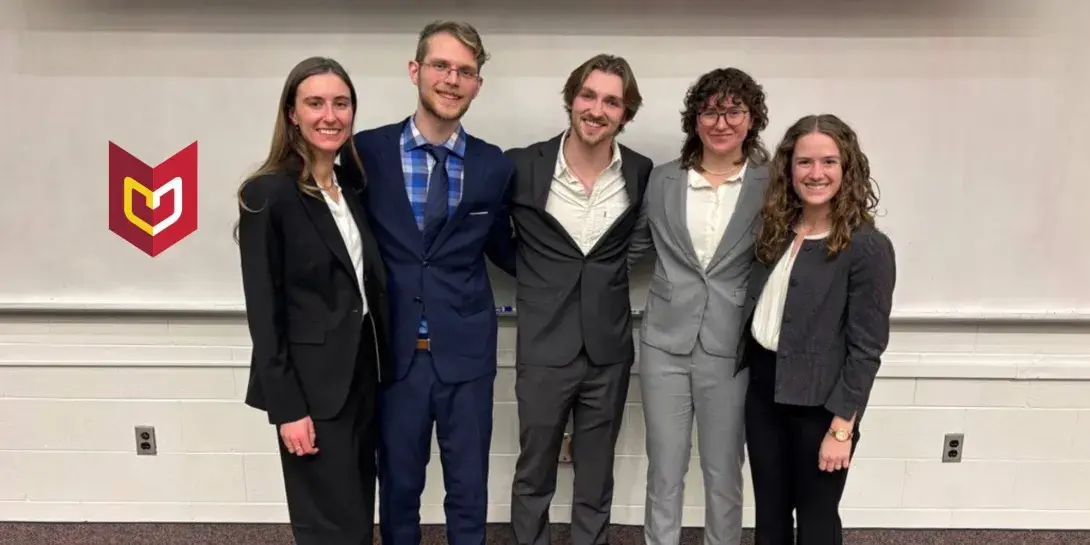
(From left to right): Mechanical engineering majors Dafna Heule, Ethan Bosscher, Brayden Meyer, Jude Veldboom, and Ava Tatko.
In early September, a senior mechanical engineering class at Calvin University was asked this question: “What would it take for the city of Grand Rapids to establish and operate a green revolving fund?”
The question wasn’t theoretical. The practical implications were real. The customer was the mayor of Michigan’s second largest city.
For the next three months, the students divided into teams focused on policy, finances, and energy efficiency projects—working together to answer the question.
On Tuesday, December 9, 2025, five student representatives presented their answer in a public seminar to the mayor and other municipal sustainability leaders. While their recommendations may ultimately lead to exciting new initiatives for the city, the student presenters say their experience over the past few months has sharpened skills they’ll use throughout their life.
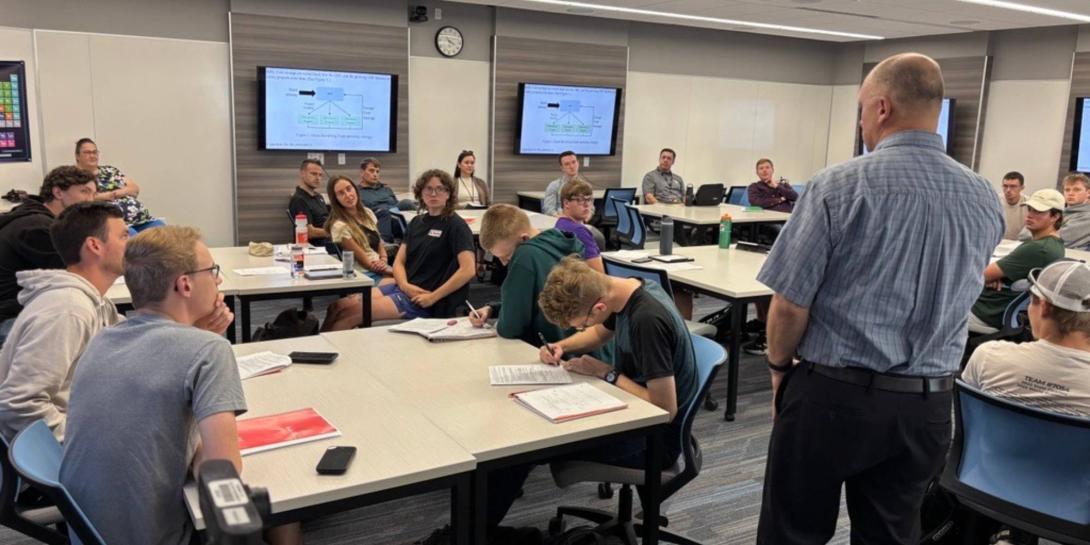
On September 4, 2025, Matt Heun posed a big question to his ENGR 333 class.
What was your initial reaction when you heard about the project?
Jude Veldboom ‘26: I’ve never been presented with such a large-scale project, and in my head, I was just thinking ‘we are going to flounder, and I have no idea where this is going to go.’ But there was also a lot of excitement.
Brayden Meyer ‘26: It got my mind spinning, because I can see we have an opportunity to directly impact the city that we’re in. That’s a very cool thing, because it’s very tangible.
Ava Tatko ’26: Honestly, I was a little bit scared. We had just started senior year and all of a sudden Professor Heun told us our client was going to be the mayor of Grand Rapids … I was a little bit nervous at first, but I’ve been very pleased with the support and direction that the project has taken, because I think we have ended with something that is very good.
What’s the biggest challenge you faced throughout the project?
Jude: The biggest challenge I think our whole class would agree was communication, trying to figure out as five or six different teams how to work together toward this one goal and stay on the same track throughout this semester.
Dafna Heule ‘26: Something that was challenging is not knowing the quality of work that was expected of me because I think I wanted to create something so amazing, but I had no idea how … Typically in your classes you know what exactly is expected of you. So, to kind of create your own expectations for yourself and what your deliverables are was a challenge.
Ethan Bosscher ’26: One of the most challenging parts of doing the project is that it is something you’d do in the workforce. There’s a lot of the interpersonal soft skills that are very important for actual engineering out in the world that you never have to do in a traditional class, so there’s a lot of skills we were all building throughout the process.
When we started, we had to be introduced to going and talking with other teams and giving them what our expectations are and what we need and also trying to think how can we help the other teams, ‘ooh, I bet they could really use this information, we should message them.’ So, just the perspective of we’re a whole class working together for a project and so the faster we can get information to other people the faster they can do it, so the interdependencies of real-life work came into play.
What was the experience like receiving regular feedback from city leaders?
Dafna: I liked the experience, it was a good challenge, and it was representative of what might happen in my future career. It can be hard because you get so in the details about your project or what you are working on for those two to three weeks and then you have to present it to someone who hasn’t been involved in that process with you and maybe you need to change something or step back and look at it from a more aerial perspective and that can be hard. It required some almost mental gymnastics with the project to shift the focus.
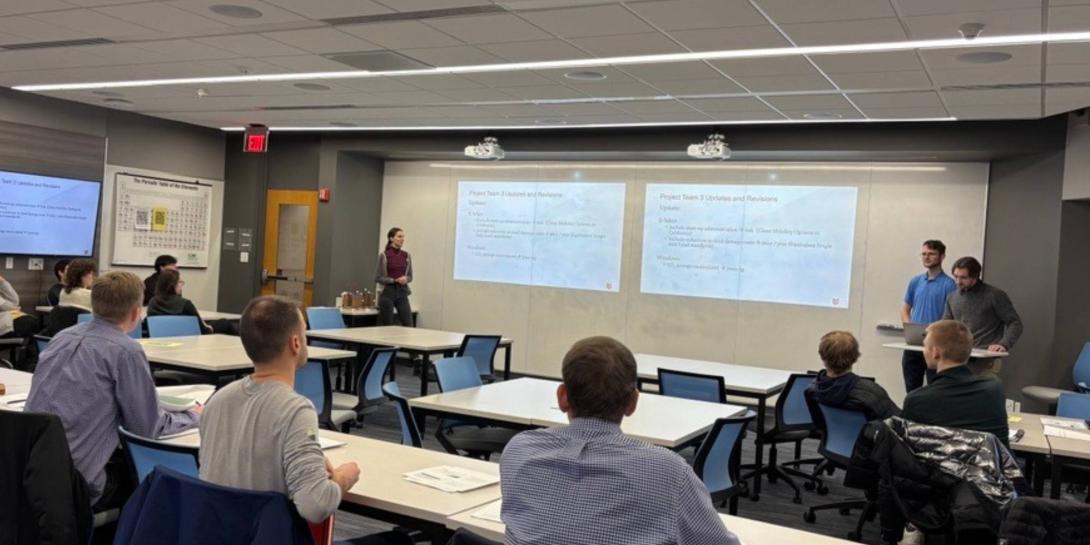
Multiple times throughout the semester the mayor and other municipal sustainability leaders attended in-class presentations to receive updates and provide feedback.
Brayden: I think the first thing that stood out to me was how much they cared about the project and our progress on it that they were willing to set a time every other week to come to campus to hear updates and provide feedback. That meant a lot to me because I could see how much our contributions meant to them.
Ethan: Giving the presentations to the mayor and all the dignitaries was a really cool experience as a student because you see these people, you hear about what they’re doing and there’s a big difference between an engineering student and the mayor, but for this project we are all coming together with the goal of making a successful project. So, it was fun to be treated like normal engineers. We are all kind of on the same level, all working together for a goal and so that was a great experience that you don’t really get anywhere else in other classes.
Ava: It was incredibly gratifying to see their interest in our project. They spent a lot of afternoons sitting with our class listening to our presentations in the classroom that we also had lecture in. But it also added a feature of quality to the overall project, because we were able to implement their direct wishes and feedback into the direction that we took.
What’s a skill you further developed during this project that will serve you well in the future?
Jude: Communication, just on a larger scale. I think growing up you naturally have to learn interpersonal skills. But understanding that communication line on a wider scale between different groups, that was instrumental for my career.
Dafna: To be a more effective leader in the future, one thing that I want to put more time into is understanding how my group members operate, what kind of structure do they work best with, and what’s going to make us the best team possible based on the different personalities or preferences that people have.
Brayden: One of the main skills I learned in this project, out of necessity, was written and graphical communication. If I understand exactly what something is or how it was done that is only good insofar as I am there to explain it. But if someone else can see a figure I’ve made, read a table that I’ve made, or a read a paragraph that I’ve written and be able to understand what that is, what it means, and how it applies, then that’s where you can really make progress. And that’s the necessary means to get work done between groups, but also to share that work with the delegates that come in every other week.
Ethan: Because we were as an executive team charged with organizing and leading our smaller teams we needed to learn how to manage a group of people to get to the goal, not just expecting people to automatically know what they are supposed to be doing and how that fits into the bigger picture … Over the process of the project, we learned that that was very key to having a team that worked well, fast, and was able to get the results that we needed in a timely manner.
What do you hope comes about from the work you’ve done?
Brayden: The overarching goal for this project was to determine what it would take to establish a green revolving fund in Grand Rapids. I think we have done an excellent job as a class estimating the feasibility—not only the feasibility of whether or not it was possible, but also how you could implement it and some different ways to scale it. We’ve tried to share it best we could. I would love to see this project go into effect because it’s not driven by abstract opinions and other things, it’s something more concrete where you can say ‘if these projects are working, they fund more projects like these.’ So, it’s a self-growing, self-sustaining thing that relies on proper implementation and technology to ultimately help the city and the environment.
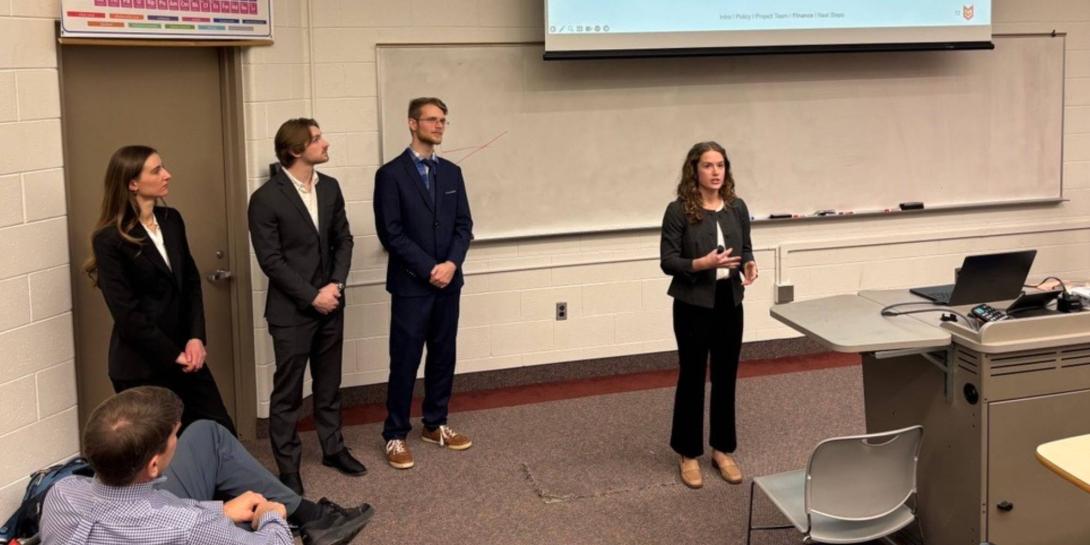
On December 9, 2025, members of the executive team gave their final public presentation.
Dafna: I hope our work does go somewhere as that’s always nice when you put a lot of hours into something … I think it can be very unifying for sustainability in a divisive world because it has that kind of fiscal conservative element to it while still holding social and sustainable responsibility.
Ethan: First of all, I’m very proud of the whole class and the team about the work we’ve been able to get done. I would be very satisfied to see this go into effect in some way, because that adds a lot of then value to all the work that we’ve done. All the hours we’ve put into this will have an impact on the city. When we compile all of the amazing work that we’ve done I hope this is something we could hand to another actual engineer with years of experience, and they are able to use it and get valuable information out of it.
Ava: I think we’re all hoping that this fund is actually implemented by the city—the mayor proposed it to us initially with that being the goal, and I think he’s planning on bringing it up sometime in the spring semester officially. It would be so cool to see some of these projects implemented, even if it’s 20 years from now, and to know that the work of a random engineering class at Calvin contributed to that.


