Award-winning film written in one night, behind bars
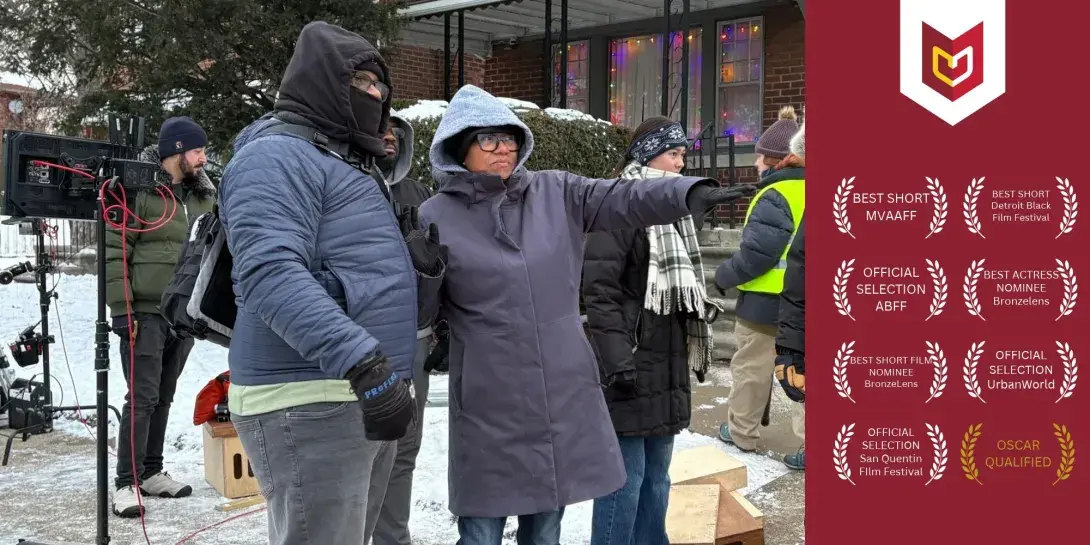
Director Christine Swanson discussing a shot for "Basement People" with cinematographer Richard Vialet.
Kyale Williams’ short film Basement People recently won the Best Short Film at Martha’s Vineyard African American Film Festival, which means the film is now Oscar-qualified in the Short Film Category.
Williams wrote the script in one night … and he did it from behind bars.
A recipe for disaster
Williams grew up amidst trauma, dealing with poverty, abuse, insecurity, and homelessness.
“I was a daydreamer,” he said.
For Williams, it was an escape.
“An interesting trait of traumatized kids is escaping into fantasy to cope with the world and so I was a vivid daydreamer growing up,” said Williams.
After high school, he went looking for order. He started taking classes at a local community college and then soon entered the military. He was deployed to Iraq and felt he was doing good work in civil affairs there. He met the local people, learned their culture, built relationships, and collaborated with the Department of State, USAID, and the Corps of Engineers on reconstruction projects.
What he hadn’t anticipated is “we would get blown up nonstop,” said Williams.
Williams came back home with post-traumatic stress disorder (PTSD). “I was not sure why I was so sensitive or so disproportionately impacted compared to my battle buddies,” said Williams.
He later found out that he had a predisposition to PTSD because of adverse childhood experiences. After the war, he went from being a dean’s list honor society student in community college to dropping out.
A life-altering decision
He turned to drugs to self-medicate. “I essentially became a burnout and gave up on life.”
Then, early on a Sunday morning, the war hit the homefront. Williams got a call saying his sister was in grave danger, being held against her will. Acting with a soldier mindset, he raced down to rescue her and admittedly made a decision that he thought in the moment was self-defense, but upon reflecting later, agreed was actually murder. That decision landed him behind bars for a long time.
For years, Williams had been looking for “order” in life amidst his chaotic environment. It was a reason he initially chose to study biology at a local community college. He said while his social systems were in chaos, he could go open up a biology book and “see how a cell works this way every time, cooperates with every other cell, shares the glucose, shares the oxygen.”
Thrown back into chaos
Unfortunately, Williams’ first stop inside prison didn’t reflect that same order he had been searching for. It was total chaos.
“You were surrounded by people who are so angry, so predatory, and it can be very scary. Men in this setting, especially young men desperate for purpose, desperate to belong, start joining gangs, so there will be gang wars,” said Williams. He recalled an especially violent incident while he was at Michigan Reformatory that strongly brought on his PTSD.
Williams’ early journey inside prison was leading him into a state of hopelessness.
“The stigma of my crime, my mistakes, and being incarcerated was so heavy that I longed for a pathway toward redemption,” said Williams. “There’s something about hitting rock bottom that makes you want to get on your knees and beg God and the Spirit for an answer.”
Led toward education
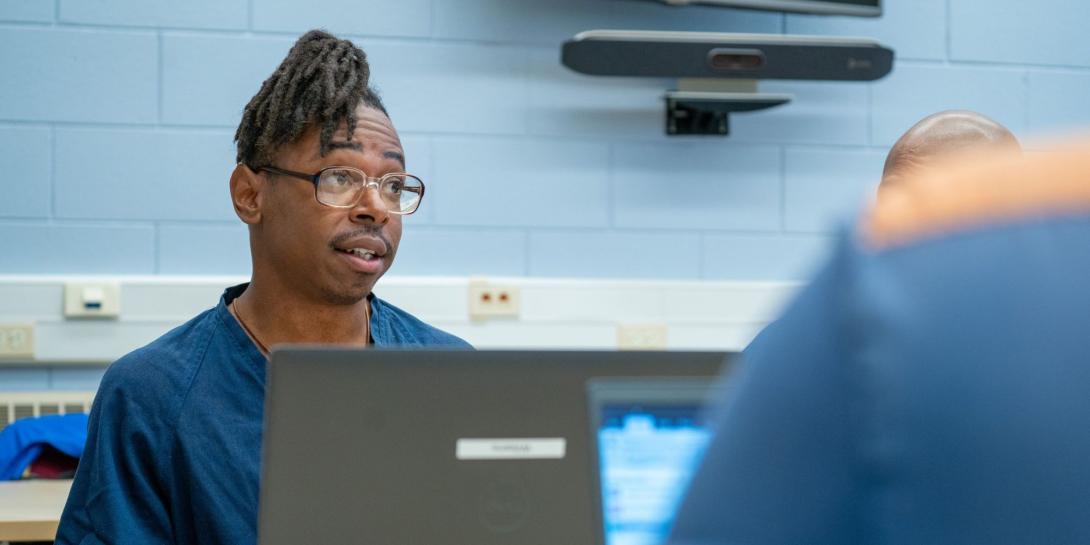
In that moment, Williams says “I believe the Spirit said ‘stop playing around and go get educated. Find a way to give back.’”
And so Williams started entertaining the idea of what it would mean to become a sociologist. He wanted to understand why his life was the way it was and why he went through the things he went through and how he can make them better.
He asked around and got money from friends and loved ones and signed up for a correspondence course through Adams State University. He loved it, did well, and had started to dream of what he’d do with his education. Then, just as quickly as hope started to return, he realized he couldn’t afford another course. And because he had taken a loan outside of prison for his previous education, he had no access to financial aid.
His future had seemingly hit a dead end.
But then he saw something come on the TV in his cell.
Given a glimmer of hope
“I’m watching the news and they are talking about a graduation at Handlon Correctional Facility through a program called Calvin University and I’m seeing men like me do what I really want to do and they look happy,” recalls Williams.
So, he found out how to apply, was accepted into the program, and, in 2023, he entered it thinking about himself and his future.
“I’m thinking career,” said Williams, upon starting the Calvin Prison Initiative (CPI) program. “I’m thinking, ‘wow, if I go to Calvin University, I can get this degree and I’ll qualify for the jobs I want to have, and I’ll get out and have a great job.’”
On day one, those expectations were shattered as his vision for the future was expanded.
Encouraged to expand his vision
“You get here, and you realize very quickly they expect so much more from you than getting a good job,” said Williams. “This program expects you to be a member of a community, they expect you to love, support, and serve other people. They expect you to transform, to battle some of the demons, to thirst for virtues, to maybe even tap into your God-given image and find a little bit of faith. Now that’s a tall order, and it’s not what I initially signed up for.”
But it’s exactly what Williams needed.
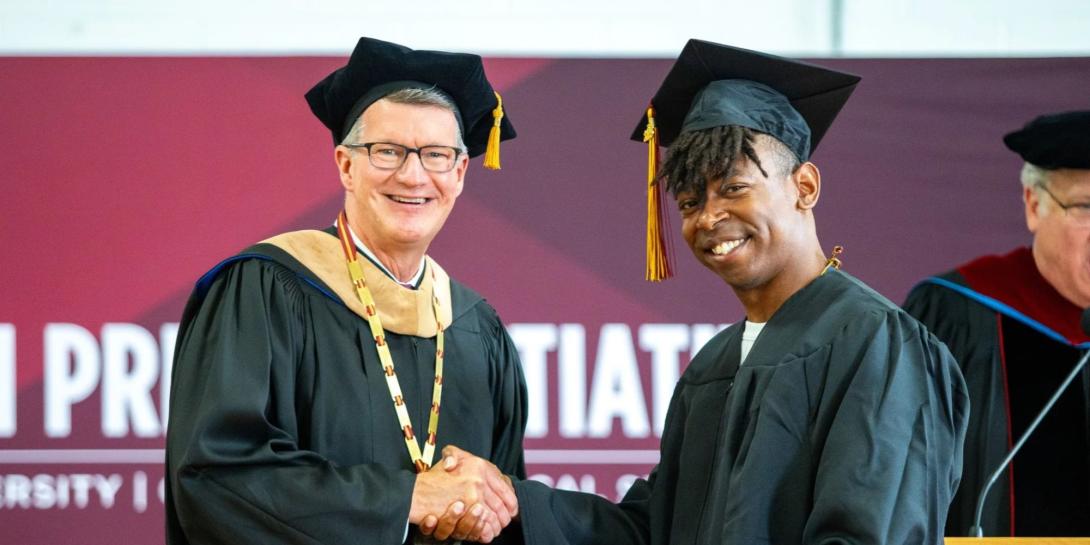
President Greg Elzinga shakes Kyale Williams' hand in May upon him receiving an associate's degree inside Handlon Correctional Facility.
“You come in here feeling hopeless, disempowered, like you don’t matter, and you have no say in anything,” said Williams, “and then CPI teaches you that that’s not true. As a child of God, it absolutely cannot be true. As a child of God, you absolutely play a role in stewarding how your environment goes. You might not control the administration, you might not control the prison policy, but you can, at the very least, be the love your brothers need in this environment.”
Williams continued taking classes in CPI, working toward a bachelor’s degree in faith and community leadership and human services. And then something unexpected happened.
“No one would have ever thought it was possible and it’s unprecedented,” said Williams.
An unexpected offering on the inside
Williams and his cohort in CPI were going to take a screenwriting class.
“We thought they were joking,” recalls Williams.
Then, in 2025, “there we are sitting across from Geert Heetebrij, who’s been in the industry for 20 years and he's worked with celebrities and everything else and he says to us in this short amount of time you’re going to write three scripts.”
“Growing up I had always daydreamed my own movies in my head. I would literally watch them: my own cartoons, my own comic books, my own video games. But I never imagined in a million years I could do anything with that,” said Williams. “I feel those ideas always died in my head, and that was kind of tragic for me.”
Out of his head, onto the page
But now Williams seemingly had an outlet, and so he started to learn from Professor Heetebrij how to format and structure a story. But he was called to think deeper too … he was taught from a reformed Christian perspective how the greatest stories mirror the arc of creation, fall, redemption, and restoration.
Throughout the semester, he wrote the three required scripts. All three were given A’s. Heetebrij was clearly impressed, but Williams wasn’t satisfied. So, when Heetebrij asked the class to pick one of their three scripts to submit to him because someone outside of prison might want to produce it, Williams decided to start from scratch.
“The three I produced were merely written to entertain. They didn’t go deep enough,” said Williams.
A cup of coffee, a few hours, an award-winning script
So, with almost no time to work through a semester-long process of writing a script, he sat down with a cup of coffee and started writing. By morning, he had written Basement People.
“I read it and was blown away by it,” said Heetebrij, a professor of communication at Calvin University.
“I felt something was different [with this script] because I was finally writing what I knew, where I came from, from the trauma I know, what it sounds like, what it feels like, how it makes you want to run screaming,” said Williams. “I finally captured my experiential realism on the page.”
Afraid of how the rawness of the film might be received and the ugliness of the truth it unveiled, Williams recoiled when Heetebrij asked if he wanted to submit the script to be considered for production.
“I said ‘no, you cannot take the script to anyone. You cannot do anything with it’ because I was 100% certain that no one would know what to do with it,” said Williams. “I thought that they would look at it and go ‘wow, this will cause shame, this is raw, this is painful, let’s move onto something more joyful.’”
Walking back to his cell block after class got out, something changed.
A single step of obedience
“I say it’s the Spirit. I heard a voice, not in words, but a feeling, like almost in my gut, that said ‘I know you won’t understand why, but just listen to me, go to the LRS system [email system inside prison], send Professor Heetebrij a letter right now explaining to him that he can use your script.’ I said to this voice, ‘well, that’s nonsense, no one wants this very raw story.’ But then the voice came back, and I listened, I obeyed.”
Williams said he didn’t think anything would come of it, but then Heetebrij began to share the script with colleagues in the industry and was soon connected to Christine Swanson, an African American filmmaker who grew up in Detroit, the setting of Basement People.
“I sent her the script,” said Heetebrij, “and she read it, and she thought, ‘this is about my family.’”
She agreed to produce it and hired Jaki Brown as the casting director.
“She did the casting for top movies,” said Heetebrij. “Quentin Tarantino actually named a movie after her.”
Turning weakness into strength
The script, written in one night, was made into a short film within six months.
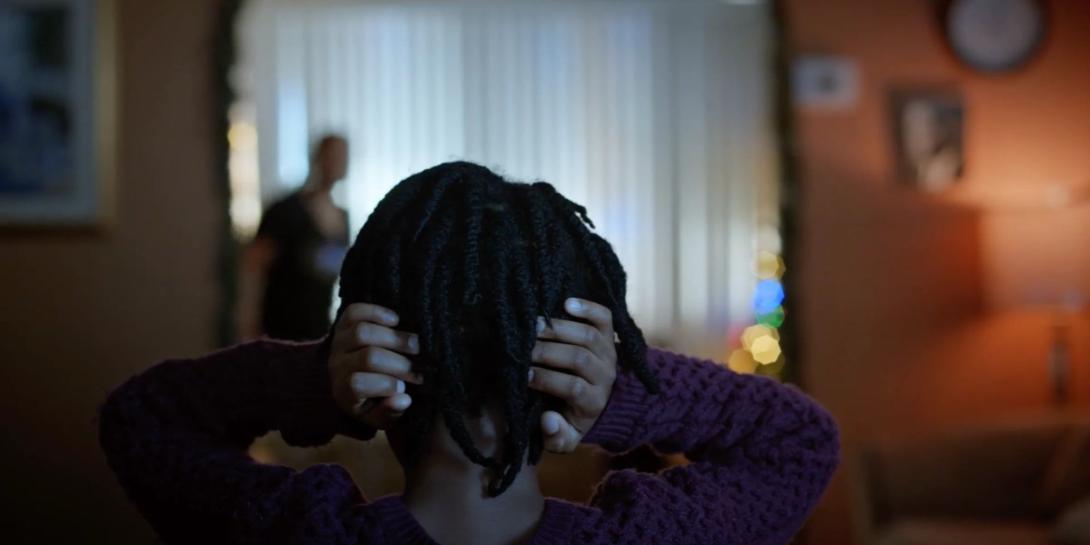
A shot in Basement People where Tina is covering her ears to drown out the chaotic environment in the house.
“I was surprised but Professor Heetebrij saw something I did not see, and I guess it helps for him to have all those years of experience, because for me I did not see it,” said Williams. “All I saw was my trauma and I did not know yet how to relate to my trauma as a strength instead of a weakness.”
Williams now sees his screenwriting gift allowing him to do just that and as a way to help others inside and outside of prison get unstuck and to move forward in life.
Helping others discover a hopeful future
“When Heetebrij taught me that storytelling was a spiritual discipline, I made a vow to move deeper and beyond mere entertainment, and so my stories must now be an exodus from the hard, broken, painful places we are to where God wants us to be,” said Williams. “That short film, Basement People, is a snapshot of where so many of us are and where we have been. It’s time to expand this story to where God wants kids like Tina [main character in Basement People] to be. He wants them to be happy, He wants them to be safe, He wants them to belong.”
Williams hopes the film helps prisoners see that they are not alone. He also wants it to receive an Oscar nomination next month so that people will see that every skill and talent exists behind bars. He also wishes it soon would get turned into a feature length film. After all, he already wrote the full length script. That took him just five days.
“Basement People is a very traumatic experience and so the only thing that can come after this short film is how does God deliver them? How does God disrupt these cycles of violence? What might it look like for Tina [main character of the film] to courageously go up those basement steps to live in the upstairs again?” asks Williams. “I want that. I want people to see a longer version that delivers this family in some way.”
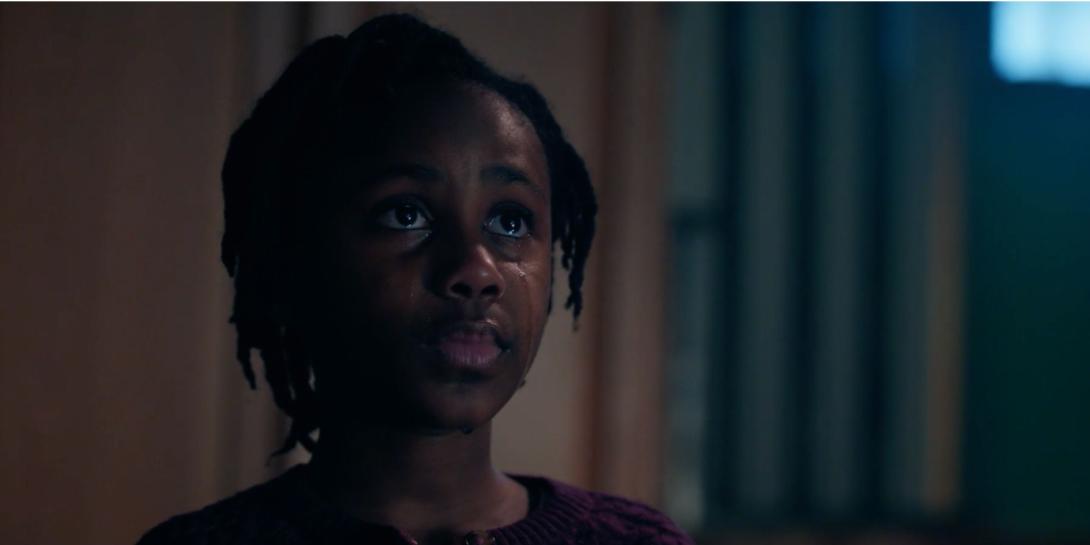
A shot of Tina crying in Basement People.
After all, Williams has experienced that deliverance. Though behind bars, he’s now living with purpose and ready to serve however he is needed to help his fellow inmates to derive meaning from trauma and then to use those experiences to transcend.
And he’s doing this work within a community that affirms him as an image bearer of God every day.
“They let you know immediately that you matter, that you are loved, and that you have gifts to share simply because you exist, simply because you are made by God. You do not earn it. You do not win it. You only need to embody who you truly are,” said Williams. “So, it refrains the need to compete, to fight, to convince, to persuade, to manipulate. It gets rid of that and replaces it with a security I have never had before in my life, not even in the military, which places heavy emphasis on solidarity, but not like this, not that God-breathed belonging, and what that does is it becomes easier to believe I am loveable, I have a purpose, that people deserve the best I have to offer.”
And the best is yet to come.


