Building lives of purpose inside prison

Graduates of the Calvin Prison Initiative's Class of 2026 gather for a photo prior to their Commencement celebration on May 21, 2026.
In 2015, Calvin University, Calvin Theological Seminary, and the Michigan Department of Corrections (MDOC) took a chance on a first-of-a-kind program in the state of Michigan—the Calvin Prison Initiative (CPI). This year, CPI celebrated a milestone: it’s 100th graduate.
Through the program, each year a cohort of men begins their pursuit of a bachelor’s degree behind bars. The goal of the program, which is funded entirely by private donations, grants from the state of Michigan, and Pell funding, is to provide a transformative experience through education.
Now, eleven years in, the program has been a resounding success. And, as intended, the program isn't just changing prison culture inside the fences at Handlon Correctional Facility in Ionia, Michigan, it's having ripple effects throughout prisons statewide. In fact, there are now more than a dozen higher education institutions in the state who are operating educational programs inside prison and graduates of the CPI program are now serving in five MDOC facilities.
CPI grads are serving as peer mentors for mental health or substance abuse programs, providing tutoring for trades and postsecondary college and GED programs, and serving veterans and those in hospice care.
Regardless of where they are serving or what they are doing, the men who have now graduated are clearly living lives of purpose and seeing how they can be Christ’s agents of renewal wherever they are—including behind prison walls.
The graduates from the Class of 2026, who received their diplomas on Thursday, May 21, are ready to do the same and they reflect fondly on their formative five years in CPI:
Before I was accepted into the CPI program, I felt …
Leon: Stuck, stagnated, and at times invisible. No matter what facility I was housed at, I was just stuck in the prison loop of doing the same thing every day, reading, writing, and working out. While I wasn’t hurting anyone with this behavior, I wasn’t helping them either, nor was I growing.
McConnell Adams, Jr: Like I did not need a post-secondary education. Full of hubris and a touch of lingering rebelliousness against any formal system, I believed my unstructured learning efforts were sufficient to get me where I was headed. Thank God I was completely wrong. I not only needed to learn in a structured learning environment, I needed the degree path Calvin offered.
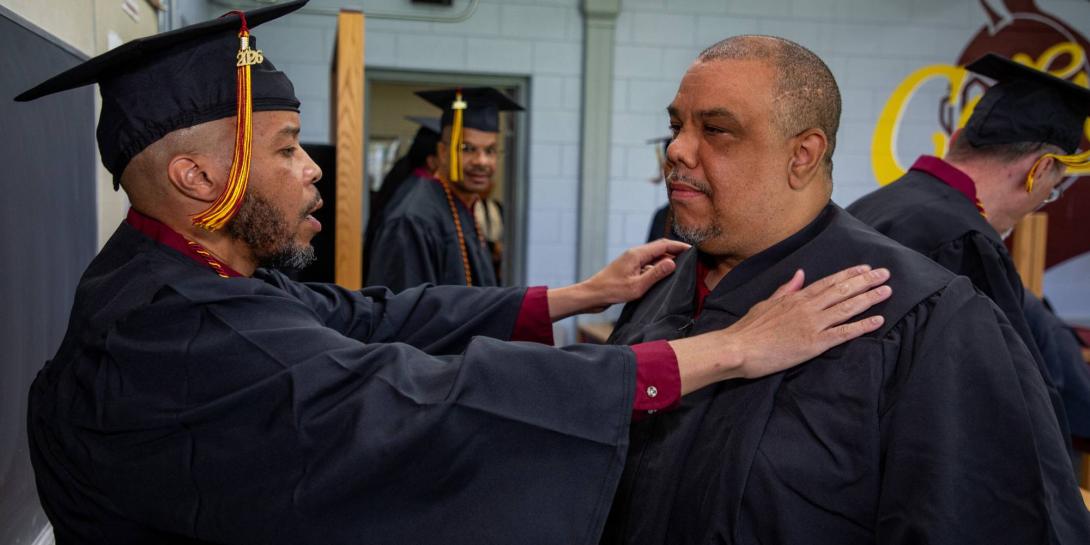
McConnell Adams, Jr. and Eric Cliffton-Arnett Rackard getting ready for their 2026 Commencement ceremony at Handlon Correctional Facility.
Eric Cliffton-Arnett Rackard: I felt as if I had reached a point in my life where I could not grow any further on my own. I felt like a plant raised in a glass jar with the lid closed tight. Calvin University took the lid off, took me out of the jar, and planted my roots in the luscious soil of higher education. Now I feel like I can grow forever.
Upon graduating from the CPI program, I feel ...
Dwight J. Smith: Upon graduating from the CPI program, I feel that my calling is to preach and teach the gospel of Jesus Christ continuously and to help as many as I can come to the truth of God and teach myself to trust God more than I have in the past regardless of the situation that is set before me.
Richard E. Jackson, Jr: I feel a deeper relationship with the Father, Son, and Holy Spirit, which has helped me find my calling—Kingdom Building. Now, I am equipped with the tools for serving humanity, which will help me create beloved communities.
Gregory Mox: I feel like popcorn about to pop. I feel vocationally inspired to change the things that bother me into things that please God. I feel love for all humanity, indeed all creation, which gets burdensome. I feel gratitude for providence, so that I can trust God to take care of the big picture and I may focus on my small part of His work in front of me.
McConnell Adams, Jr: I see the world through much wider eyes and it is not as scary as it once was when I was functionally uneducated. I am a learner for life.
What’s your greatest takeaway from the past five years in CPI?
Richard E. Jackson, Jr: Knowing that the CPI staff had a vested interest in restoring dignity in a person. Additionally, there are students in the CPI program that had a vested interest in citizenship in a carceral setting and restoring community. Collectively, the CPI staff’s dedication to the program, and CPI students’ commitment to learning, gives hope that positive change is coming in the prison system.
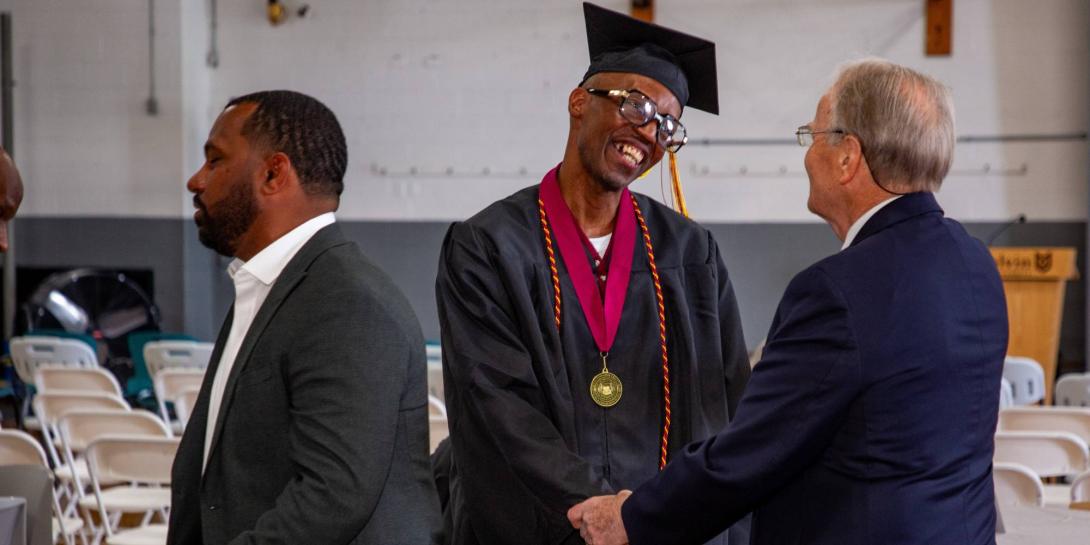
Richard E. Jackson, Jr. is greeted by one of his CPI professors, Dale Cooper, after the 2026 Commencement celebration at Handlon Correctional Facility.
Kyle Boldrey: Being able to identify and understand my emotions. This has allowed me to cultivate positive habits and coping mechanisms for the ups and downs of life. Additionally, it has allowed me to help my family and friends better understand their emotions.
Ben Vander Ploeg: That God has not given up on me, but actually has plans to use me to perform His will. In fact, God has given me the strength and guidance to succeed in whatever task He places before me. Because of this, I need not worry about possessing the ability to succeed, rather through Christ I can do all things.
Nima Nassiri: Prior to CPI, I had an individualistic mindset, but this education opened my eyes, and I am so grateful for it! Education is meaningless if it is not applied to the welfare of others. That is my greatest takeaway!
Robert B. Moore: It would have to be that ‘what comes from the heart touches the heart.’ Every professor, equipped with a wealth of knowledge and skill, gave abundantly to each student. And now that I know a little more, I will just as eagerly share with (and encourage) others to pursue their own next-level education.
What has the CPI program prepared you for?
Gregory Mox: The CPI program prepared me to contribute vocationally to society. Whether I am released from prison sooner or later, I know that I will be about the Lord’s work … God gave me a great many gifts, few of which I developed properly, but my story is far from over. I hope to honor my gifts by using those gifts well.
Nima Nassiri: I am honored that my education has led me to create a domestic violence prevention blog (DomesticHealing.com), to share my story and connect others to resources that can assist them in preventing violence from occurring in their lives. The site is one way of redeeming the brokenness of my situation.
George Kruger: To be the kind of leader in my community that my peers need. I can now confidently offer my peers that safe and trustworthy relationship we all may need at times.
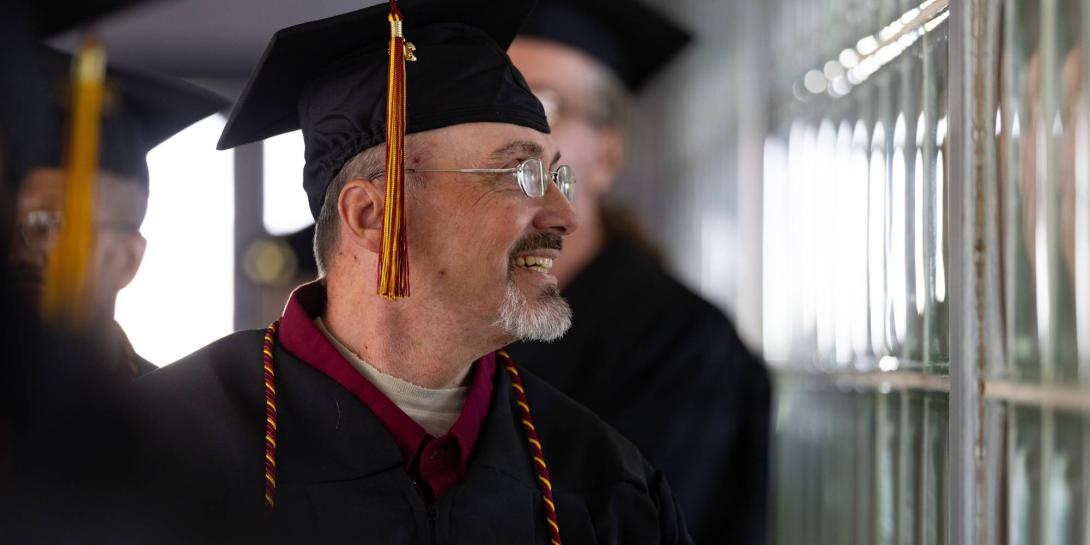
George Kruger lines up to graduate at the 2026 Calvin Prison Initiative's Commencement ceremony inside Handlon Correctional Facility.
What’s a favorite memory of your time in the CPI program?
Cliffton-Arnett Rackard: Giving my introduction speech during our first semester as a cohort. Looking out at all the people who had been given an opportunity to better their lives by claiming their education, and seeing all the hope, fear, anxiety, respect, honor, confusion on all of those faces and thinking ‘these are my brothers.’ It was the moment when I knew I was a part of something greater than my own aspirations.
Robert E. Hine: Hands down, my favorite moments sharing space with others in this CPI program were during talent shows. Seeing how the CPI faculty engaged with us in the spirit of community is life affirming.
Ben Vander Ploeg: My favorite memory goes back to the beginning of the program when I was not only greeted by upperclassmen with open arms, but was also welcomed by the Calvin staff as a normal human being.
Robert B. Moore: My favorite memory has happened more than once. It was when I felt like a scientist after taking a biology course. And it was when I felt like a social worker after taking every social work course. It was also when I felt like a budding pastor after completing the ministry leadership course “Forming Worship Communities.”
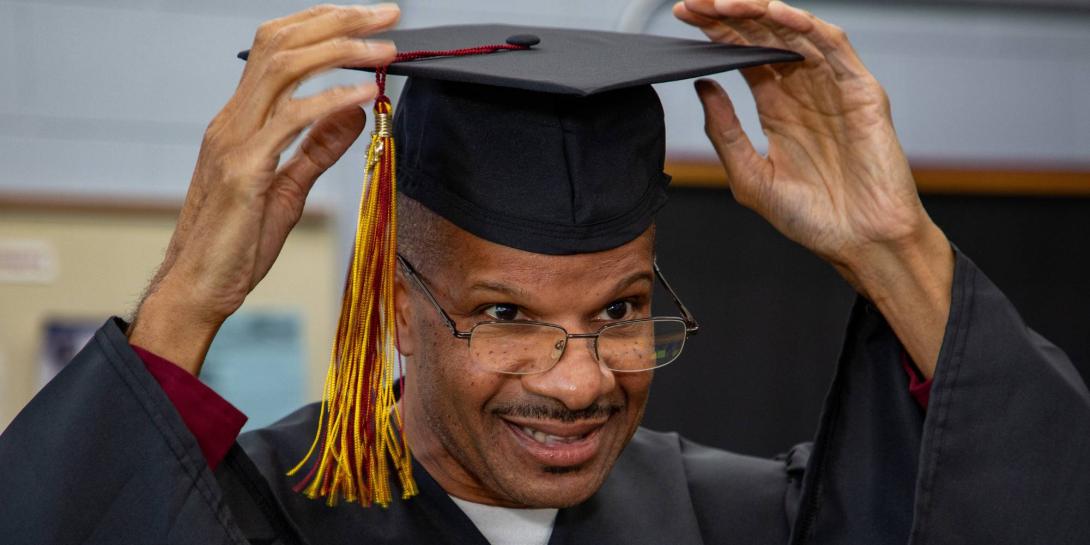
Robert B. Moore adjusts his cap prior to the Calvin Prison Initiative's 2026 Commencement ceremony inside Handlon Correctional Facility.
What are you hoping to do now that you have your bachelor’s degree?
Leon: While I am still in prison I plan to be a tutor/mentor/example, and just helping wherever needed. Outside of prison, I plan to lean more towards the mentoring troubled youth and public speaking route, really just sharing my story, letting them know that I understand, and that there is a better way.
Robert E. Hine: With permission and guidance from the Chaplain I hope to form a culture of discipleship by developing a Discipleship Club … I also hope to be a developer in the process of building a network of resources for men to be aptly equipped to parole into communities of great need and have the capacity to serve in those communities.
McConnell Adams, Jr: Get my master’s no doubt. I could see a future where Dr. precedes my surname.
George Kruger: To put that degree to work in forming programs that will assist my community in becoming the best they can be.
Deron James: I hope to work in the social worker field, to help those with special needs learn how special they are, and I would like to be an advocate for those who need it the most—the less fortunate, at-large youths, juveniles, and homeless. I would also like to start my own shelter program for the homeless when I am released from prison.


