Where grads become good for the world
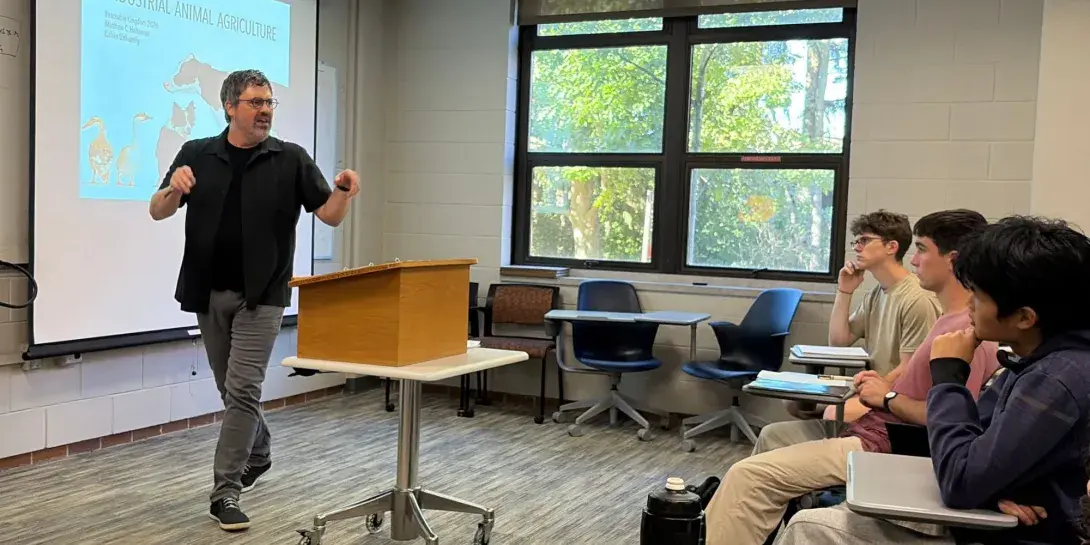
Matt Halteman, professor of philosophy at Calvin, teaches his class on September 29, 2026.
David Clough is one of the most influential Christian scholar advocates in the world working on food systems transformation. On October 1, he’ll be on Calvin’s campus.
“I just love the fact that Calvin is a place where one of the world’s best, most celebrated Christian theological ethicists wants to come to share ideas first,” said Matt Halteman, professor of philosophy. “David’s work is the gold standard.”
While Clough will give a public lecture in the Animals and the Kingdom of God Lecture Series, he’ll also be in Halteman’s classroom talking directly with students.
“If I’m a Calvin student, that makes me excited about the place I’m going to school,” said Halteman, “to be somewhere that I can walk into the classroom and engage a world-renowned theologian on an average Thursday.”
And then the next day, Halteman’s class and the Calvin community will be able to interact with a Jewish religious studies scholar, Aaron Gross, who is a world authority specializing in the Hebrew Bible and food systems.
“Aaron also happens to be the co-founder of one of the most influential food systems transformation advocacy organizations in America,” said Halteman. “So, this is incredibly exciting for anyone who is really in it to win it in terms of education.”
Where experts are in every classroom
While students have an exciting opportunity October 1-2 to engage a couple of experts, this kind of access is a common occurrence at Calvin University—which has scholars in almost every discipline who are at or near the top of their fields.
In fact, Halteman is one of them. He’s published widely on animal ethics and food systems transformation, including his most recent book Hungry Beautiful Animals. This past year, he traveled all over the country from California to Massachusetts and from Michigan to Texas presenting his work at Harvard Law School, Princeton University’s Center for Human Values, and at the Governor of Colorado’s house, Boetccher Mansion.
Where teaching and scholarship are intertwined
For Halteman, scholarship grows out of teaching, and the two deeply inform one another.
“I probably could have ended up at a school that prioritized research a bit more and teaching a bit less. But one of the things that attracted me to Calvin was that you knew that there was going to be the expectation of excellent teaching,” said Halteman. “Scholarship is important, but for me its main payoff is the way it can make one a more compelling teacher.”
“Much of the scholarship I’m known for has germinated in my classroom, in conversations with students,” said Halteman. “Chapter four of Hungry Beautiful Animals is essentially the story of my experience working with Calvin students on the question of how we build the world we want to live in from the grassroots up.”
Where students learn “how” not “what” to think
That word “how” is critical. What Halteman aims to do is not to tell students “what to think,” but rather to invite them into conversations and discussions that teach them “how” to think – how to spark curiosity and ultimately discover where God is calling them to next.
“I love that Calvin is not a think tank where everybody has roughly the same view and then we churn out little Play Doh versions of experts,” said Halteman. “Instead, it’s a refinery for self-understanding that empowers students to discern unique personal vocations to bless the world.”
Where each student is valued
While Calvin’s approach to education was appealing to Halteman as a teacher and scholar, it’s also valuable to him as a parent.
“As a parent, I want my children to have an education that invites them beyond the cookie cutter options into deep discernment about what they can uniquely offer in service to the world,” said Halteman. “I want them to feel like this is an opportunity to experiment, to come to know what matters most to them and then align their special calling with what the world most needs. That’s the wellspring of Christian joy, right? It’s asking, “What opportunities does this class offer me to turn my gifts and talents into loving service?”
Halteman says it’s about giving students an opportunity to know themselves as deeply as they can so that they’re not just settling for what society expects of them, but actually moving toward discovering what brings them joy.
Where students thrive
“When you’re learning, you’re risking something that you thought you already had figured out and you’re putting it to the test. And so, what I challenge students to do is to persevere through that tension, just like when you are lifting weights or working out a tough math problem; if you stop at the moment you feel the tension, you’ll never get the gains,” said Halteman. “The pivot from defensiveness to curiosity is the move from being worried that this professor is trying to change me to having confidence that this professor wants me to discover for myself what makes my heart sing, what brings me joy, what investments are possible for me to make in the flourishing of the world at large.
Halteman says that as a Christian, what he’s discovered over decades of teaching is “when your joy intersects with the needs of the world at large, that is when you experience fulfillment, that is when the fruit of the spirit really starts to cluster in abundance around your work.”
Where Calvin grads become the experts
So now, two decades into his teaching career, Halteman has had the joy of seeing the fruit of his and his colleagues’ labor manifested through graduates who are serving the world in many ways and actually returning to his class as experts.
“The most beautiful moments in the classes I teach are when the experts who visit as guest lecturers are former students! These are people who sat in this very class 10, 12, or 15 years ago and now they’re back as a nutrition education coordinator for the Physicians Committee for Responsible Medicine or as the associate dean for research at the Van Andel Institute,” said Halteman.
Where grads become good for the world
But it’s not what they are doing that impresses Halteman, it’s the people they’ve become that are good for the world.
“We’re not doing this to become self-aggrandizing experts. We’re not doing this to become rich,” said Halteman. “If we become experts or affluent in the process of living toward shalom, then those can be blessings. But that is not what we’re out to do. What we’re out to do is get that self-knowledge to discern what justice and joy looks like for us, and then to overflow the confines of our own individual projects into partnerships and collaboration that stretches over every square inch.”


