Shaping Nurses to Excel in the Field
How can nurses be better prepared to understand and manage pain?
It's a question associate professor of nursing, Elizabeth Byma, has spent years exploring as a nurse, researcher, and professor.
Early in her nursing career, Byma cared for a patient whose pain persisted despite her best efforts.
"I'll never forget the overwhelming feelings I had that I wasn't a good nurse because I couldn't help her," Byma recalled.
The experience stayed with her.
Determined to better understand one of healthcare's most persistent challenges, Byma eventually built her doctoral studies and much of her scholarship around pain management, exploring how nurses can be better equipped to care for patients whose pain is often far more complex than it appears.
Research Rooted in Real Patient Care
While pain management is something nearly every nurse encounters, Byma found that many struggle with it very early in their careers.
The challenge, she explains, is that pain is rarely straightforward.
"Pain is multidimensional," Byma said. "There are physiological, psychological, social, cultural, and spiritual aspects to it."
Two patients experiencing the same condition may describe pain completely differently. Their backgrounds, experiences, faith, emotions, and expectations all influence how they experience suffering and healing.
Byma's research has focused on helping nurses better understand those complexities. Her scholarship has explored pain assessment and management, the experiences of newly graduated nurses, healthcare simulation, and the role of arts and humanities in nursing education.
That work carries particular significance at Calvin.
Research-intensive scholarship is often associated with large public universities, yet Calvin has earned a reputation for undergraduate teaching. Professors like Byma demonstrate that students do not have to choose between a Christ-centered education and learning from faculty who are actively contributing new knowledge to their disciplines.
In Byma's classroom, students benefit from both.
Bringing Scholarship to the Next Generation
Over the last several years, Byma has combined her expertise in pain management with specialized training in healthcare simulation, studying how immersive learning experiences can better prepare future nurses for clinical practice.
“Chronic pain is a growing problem in the healthcare system,” chair of the Nursing department, Jaclynn Lubbers shared. “A first step in addressing this problem is to look at the way we educate nurses regarding pain and pain management. Dr. Byma's research contributes to the growing body of knowledge using innovative pedagogy, such as simulation, to teach future nurses how to best care for and advocate for patients with pain. This work is an asset for nursing education across many specialties and spheres of care.”
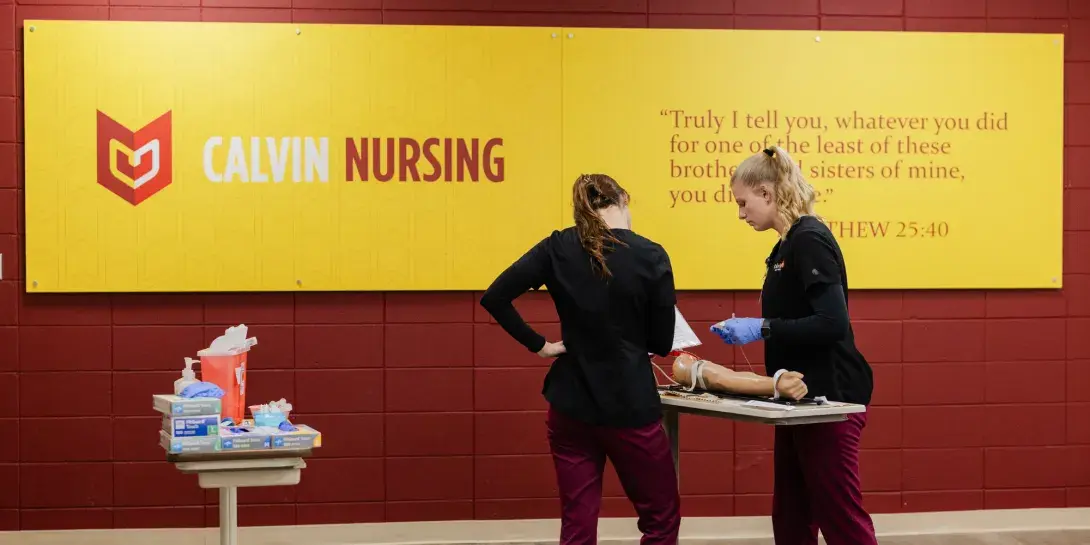
Inside Calvin's simulation labs, students encounter realistic patient-care scenarios using high-fidelity mannequins, standardized patients, and other experiential learning tools. But Byma believes one of the most valuable parts of the simulation happens after the scenario ends.
Students gather with professors and practicing healthcare professionals to debrief.
They analyze decisions. They discuss mistakes. They reflect on what went well and what could be done differently.
In other words, they learn to fail well.
That matters because nursing can be emotionally demanding. Patients do not always respond the way textbooks predict. Treatments do not always produce the hoped-for outcome. New nurses often wrestle with self-doubt when things don't go as planned.
Byma understands those feelings firsthand.
Rather than simply teaching procedures, she helps students learn how to think through uncertainty, navigate complexity, and care for patients as whole people.
A Trusted Guide for Future Nurses
That combination of scholarship, clinical expertise, and personal investment is what makes Byma such a valuable mentor to nursing students.
A current advisee of Byma’s, Manuel Lopez-Zamudio, shared, “Professor Byma is very patient, approachable, and genuinely invested in helping her students grow. She brings a great deal of nursing, teaching, and research experience into the classroom. This helps us connect what we are learning to real patient care."
Her commitment reflects something larger about Calvin's nursing department: faculty who are deeply invested in their students and deeply engaged in their fields.
For Byma, those two commitments are inseparable.
The same curiosity that drives her research fuels her teaching. The same experiences that shaped her nursing career shape the conversations she has with students. And the same Christian faith that drew her to Calvin continues to influence how she approaches both scholarship and patient care.
In doing so, she offers students something prospective nurses often hope to find in a professor: not only expertise, but someone willing to walk alongside them as they learn.