From motherhood to international stage: How Lisa Sung uses jazz to build bridges
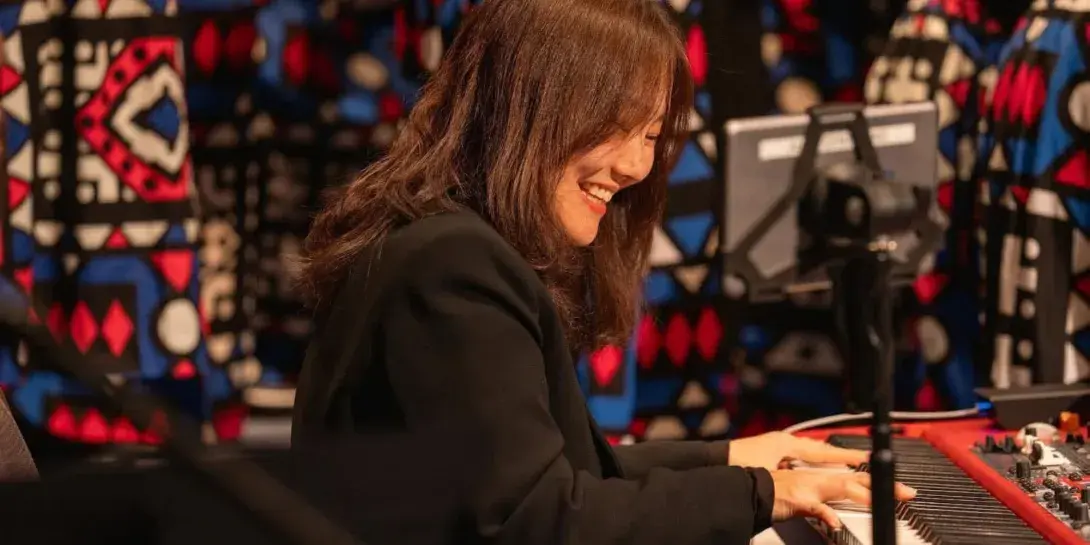
In the thick of early motherhood, Lisa Sung wasn't planning an international tour, pursuing a doctorate, or receiving prestigious awards for artistic innovation. She was a mother of six, singing Korean children's songs to her young children at bedtime and wondering whether her performance career was behind her.
Today, Sung is an award-winning jazz pianist, composer, educator, and doctoral candidate whose music has taken her across Asia, connected cultures through jazz, and earned national recognition for her artistic vision.
“I look back at the last 12 years and God was always there,” Sung said. “He just kept opening doors.”
One of those doors opened unexpectedly during a walk through Calvin’s campus.
An unexpected beginning
After moving to Grand Rapids from the East Coast, Sung was pushing her daughter in a stroller when she noticed a sign advertising auditions for the Gospel Choir. Although she wasn't a singer, her love for gospel music persuaded her to audition anyway. That was when she met Dr. Charsie Sawyer for the first time. The audition led to an opportunity to serve as accompanist for the choir, marking Sung's return to music after a complete 12-year break from professional performance to raise her children. Working closely under Dr. Sawyer, a professor emeritus of music, Sung found inspiration and a lifelong mentor. It was God opening a door for me,” she said.
The opportunity became a turning point. As her youngest children grew older, Sung began performing again, eventually presenting a faculty recital and rediscovering a calling that had never truly disappeared.
What followed would take her far beyond what she imagined.
Finding a voice through heritage
Sung's artistic breakthrough emerged from a deeply personal place.
As a Korean American, she spent years singing traditional Korean children's songs to her own children. Those melodies, first sung to her by her mother, stayed with her long after bedtime.
“I thought maybe one day I would like to do something with these melodies,” she said.
That idea became Half Moon, her debut album, which reimagines Korean children's songs through the language of jazz. The project eventually earned Sung the highly competitive John Stites Jazz Award, an honor that supports visionary jazz artists pursuing innovative creative work.
With that support, she expanded her research beyond Korea, studying children's songs from countries such as Indonesia, Vietnam, and the Philippines. Many shared themes of hope, resilience, longing, and cultural memory.
Sung formed her own trios and quartets with Michigan’s top jazz artists, leading them abroad to create collaborations that connected traditions across continents. As she traveled internationally with these ensembles she discovered that jazz offered something powerful: a shared language.
“You can meet jazz musicians from anywhere in the world and instantly communicate through jazz,” she said. “That's the power jazz has.”
Navigating global, cross-cultural musical spaces through studying and performing these children’s songs forced Sung to look inward. These experiences helped her find deeper clarity as to what it means to be a Korean American.
“For a long time, I wondered: Am I Korean? Am I American?” she said. “Now I see that identity can become a bridge.”
A scholar and an artist
Today, Sung is pursuing a doctor of musical arts degree at the University of Michigan, where her research explores cultural memory, identity, and the role traditional melodies play in shaping future generations.
Sung’s performance and research builds naturally on questions she's been asking for years.
“I want to understand where these songs came from, what stories they carry, and how they connect to cultural memory,” she said. “I want to bring those melodies into conversation with jazz and use music to build bridges between generations, cultures, and the past and present.”
Her academic success has earned significant recognition, including the Rackham Merit Fellowship and the Presidential Graduate Fellowship.
Yet Sung is quick to point out that none of it began with a grand plan.
It began with curiosity.
“I never said, ‘I'm going to get a doctorate,’” she said. “It started with small questions and things I loved. If you're passionate about something, life has a way of leading you deeper into it.”
A teacher first
Despite an accomplished performance career, Sung speaks most enthusiastically about her students.
As director of the Jazz Band, music director for the Gospel Choir, and instructor of jazz piano, she teaches students from a wide variety of majors and backgrounds. Many are not pursuing music professionally but are drawn to the community, creativity, and spiritual formation that accompany the experience.
What makes teaching here unique, Sung says, is the opportunity to mentor students holistically.
“I can pray for students,” she said. “I can ask about their prayer requests. That relationship becomes more than just a classroom experience. It's mentorship.”
Over the years, she has watched students discover confidence, purpose, and unexpected callings.
Students know her as “Mama Lisa,” a nickname earned through years of hospitality, conversations, meals, and genuine care for the people she teaches.
“To become a family, you eat together,” Sung said, reflecting on a Korean saying that links family with sharing meals. For years, she and her church community regularly welcomed international students with home-cooked food and friendship.
That spirit shapes her teaching today.
Learning from world-class mentors
Sung's story is also a reminder of the remarkable faculty expertise available to students.
As an internationally touring artist, award-winning composer, doctoral researcher, and educator, she brings professional experience spanning performance, composition, scholarship, and cross-cultural collaboration directly into the classroom.
Yet she is equally inspired by the colleagues alongside whom she teaches.
She points especially to fellow music faculty member Nate Glasper Jr., whose commitment to students and sensitivity to spiritual formation have deeply impacted her.
“He has an incredible sense of calling,” Sung said. “It's been wonderful working with him.”
Together, faculty members model what it looks like to pursue excellence in both artistry and faith, creating an environment where students are encouraged to grow academically, creatively, and spiritually.
Opening doors for the next generation
When Sung reflects on the legacy she hopes to leave, she doesn't point to awards, recordings, or international tours.
Instead, she hopes students remember the possibility that their own passions might lead somewhere unexpected.
“If somebody like me can do it, you can do it,” she said.
The mother who once wondered whether she'd ever return to music now performs internationally, researches cultural identity, and is completing a doctoral degree. Looking back, she sees a pathway defined by faithfulness, perseverance, and taking risks by being willing to walk through doors God opens.
As Calvin prepares to celebrate the arts during the upcoming Calvin Music Festival as part of Homecoming Weekend, Sung's story serves as a powerful example of what happens when curiosity, calling, and community come together.
Sometimes the most extraordinary journeys begin with something as simple as a walk.