Marketing That Matters: Learning to Do Work That Makes a Difference
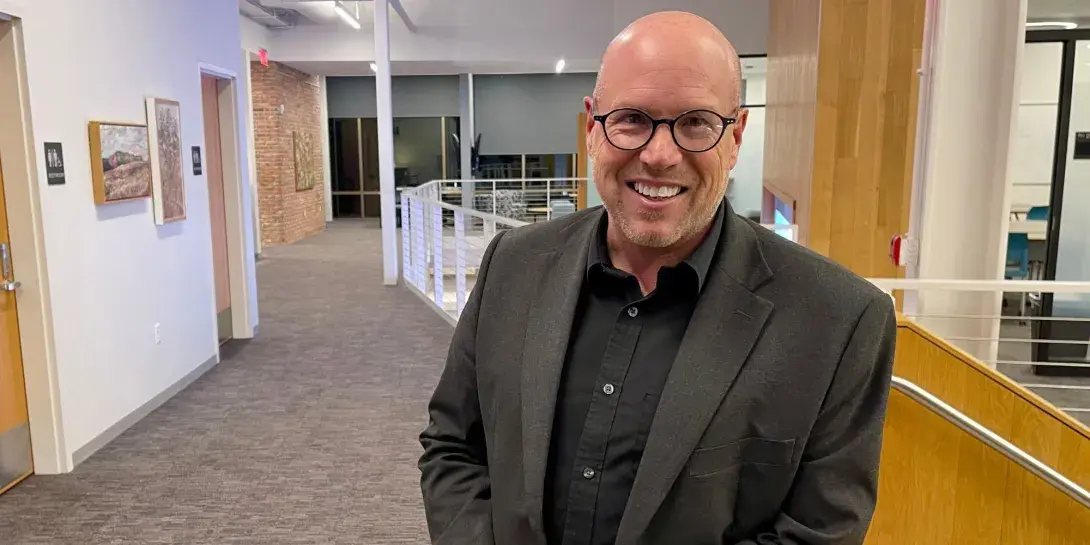
For Brian Scharp, marketing has never been just about convincing someone to buy something. He sees it as a way to help organizations solve problems, connect with people, and, in some cases, make a positive difference in the world.
Scharp has taught marketing at Calvin as an adjunct professor for more than 16 years. About two years ago, he expanded his role with the university, joining the Calvin University School of Business (CUSB) staff in a part-time position while continuing his work in the marketing industry. He is also the owner and chief strategy officer of Grey Matter Group, a full-service marketing, design and communications agency based in downtown Grand Rapids.
That combination of professional experience, educational background, and classroom teaching shapes the way Scharp teaches. His students don’t just learn marketing concepts from a textbook, they have opportunities to apply those concepts to real clients, real challenges, and the kinds of decisions they will encounter in their careers.
“I’m very practitioner-focused,” Scharp said. “While I have almost four degrees in marketing, my primary goal is to help make the learning engagement practical for our business students.”
From the classroom to the client
Marketing students often wonder how the strategic frameworks and theories they encounter in a textbook will actually help them once they enter the workforce.
Scharp tries to answer that question in the classroom.
He regularly brings professionals and clients into his courses, giving students opportunities to apply what they're learning to actual marketing challenges. Because he continues to operate an active agency that serves clients at the local, national, and global level, he has a steady stream of real-world examples to draw from.
Students aren't simply talking about how campaigns work. They are considering why certain approaches work, how organizations communicate with their audiences, and how strategic decisions affect real people and organizations.
“Here's how” is often more powerful than simply explaining “what.”
That approach also changes the classroom dynamic. Students are asked to take what they have learned and do something with it - to think strategically, work with others, and make decisions when the answer isn't already provided.
Many of Scharp’s classes are built around client projects. Students work in teams throughout the semester to address a real client’s needs.
But even forming those teams becomes part of the learning.
Scharp encourages students not simply to work with their friends but to recognize the different strengths and weaknesses God has given each person.
“If everyone in your group is an accounting major, but we have somebody in our class that's a graphic design major, you're going to want to invite someone that has some visual design skills on your team,” he said.
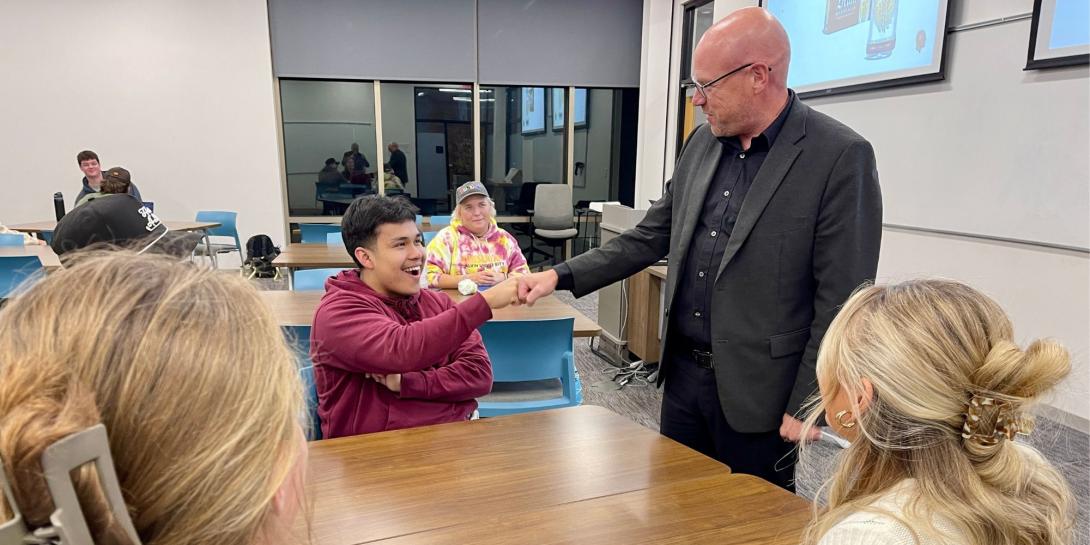
The goal is to build teams whose strengths complement one another.
That is a lesson that extends beyond a marketing class. It is the kind of experience students will encounter throughout their careers: working with people who think differently, bring different skills, and approach problems from different perspectives.
When faith and work belong together
For Scharp, connecting classroom learning with professional practice is only part of the story.
He also wants students to see that their faith and their careers do not have to occupy separate parts of their lives.
Scharp describes marketing as “redemptive work.”
The idea challenges a common assumption that business success and Christian faith exist in separate worlds. Instead, he encourages students to consider how their skills can be used to serve others and contribute to something larger than themselves.
He points to his agency’s work with faith-based organizations and nonprofits like Compassion International, Water for Good or Crossroads Prison Ministries -- organizations focused on reaching more people with the truth of God’s love. In those situations, marketing becomes a tool for helping an organization carry out its mission.
But the lesson isn't limited to explicitly Christian organizations.
Scharp wants students to understand that they can bring their faith, values, and character into whatever professional environment they enter.
“You can be a believer and engage in actively pursuing your faith, and you can do world-class marketing at the same time,” he said. “Just as Jesus came not to be served but to serve, marketing at its core is about seeing the dignity of our audience and genuinely serving their needs.”
That perspective becomes part of the way students think about their future, not simply what job they want, but how they want to approach the work they are called to do.
Learning to step into the professional world
Scharp has seen what happens when Calvin students make that transition.
He currently employs one Calvin graduate and one Calvin intern at Grey Matter Group, and he said they have been ready to contribute with less of the additional training he has experienced with graduates and interns from other schools.
One example stands out.
A recent Calvin graduate, Myla (Kar) Triemstra had been working at the agency for about six months when she joined a team working with a major client from Los Angeles. After a large industry event in Chicago, Scharp watched as she naturally stepped into the conversation with the clients’ marketing executives, facilitating discussion, building relationships and contributing with confidence.
She had been out of college for only months.
For Scharp, that moment reflected something he sees in Calvin students: they have been challenged academically, given opportunities to practice their skills, and encouraged to understand their identity and values.
“They hit the ground running,” he said.
That preparation doesn't mean students leave Calvin knowing everything. Instead, they leave having practiced how to learn, how to work with others, and how to approach unfamiliar problems.
The relationship doesn't end at graduation
For Scharp, some of the most meaningful evidence of that preparation comes years later, when former students reach out.
One former student contacted him after graduation while pursuing an opportunity at Stryker. She had made it through multiple rounds of interviews and had been given a final challenge: solve a problem and explain her approach to the company.
She called Scharp because she remembered the strategic frameworks they had discussed in class.
He didn't solve the problem for her. Instead, he helped her think through the process, reminding her of tools she had already learned and encouraging her to demonstrate how she could approach the problem even if she didn't have every answer.
A few weeks later, she called with the news.
She got the job.
For Scharp, the significance wasn't simply that a former student landed a position at a highly regarded company. It was that she had remembered a Calvin business professor as someone she could call when she faced a challenge.
“I thought that was really cool,” he said.
Those relationships are intentional in Scharp’s classroom. He wants students to feel comfortable asking questions, admitting what they don't know, and seeking guidance.
That might mean talking through a career question, helping an advisee think through a marketing plan for a summer job or simply listening.
He also values the diversity of perspectives students bring to the classroom, particularly through Calvin's international student community. When discussing a campaign, he might ask students to consider how the message would be understood in Korea, India, Singapore or another cultural context.
The classroom becomes a place where students learn not only marketing, but how to listen.
A place to begin
Scharp believes Grand Rapids provides students with a particularly rich environment for beginning a career in marketing.
West Michigan offers opportunities across agencies, corporations, startups, nonprofits, higher education, manufacturing, and other industries. Students can explore different kinds of professional environments and discover where their skills and interests fit.
His own daughter experienced that choice firsthand. After studying graphic design, she was offered a position with a company where she had completed an internship rather than joining her father's agency.
Scharp was disappointed but also pleased.
She had options.
That, in many ways, is what he wants for his students.
Not a predetermined career path, but the skills, experience, relationships, and confidence to recognize an opportunity and know what to do when it arrives.
For Scharp, teaching at Calvin provides an opportunity to help students make that connection, to take what they are learning, test it against real-world challenges, consider how their faith shapes their work, and begin discovering where they can contribute.
The next step belongs to them.


