How two students won a hackathon—and found their place in computer science
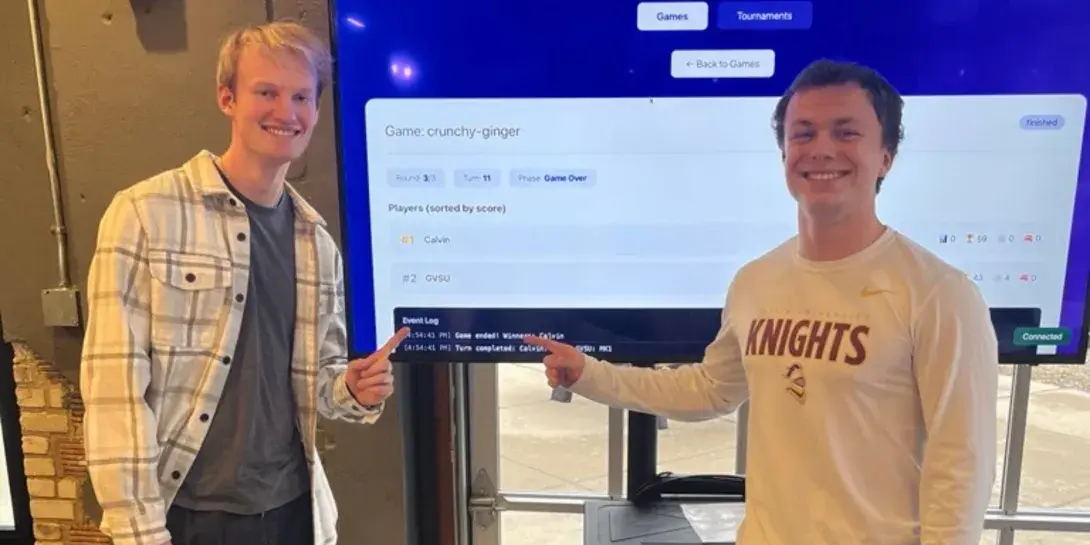
Nicholas Roberts (left) and Ben Kosters (right) celebrate after winning the 2026 Atomic Games.
This semester, Nicholas Roberts and Ben Kosters teamed up and won the Atomic Games—a hack-a-thon competition hosted by Atomic Object featuring pairings of college students from across the state of Michigan.
“Essentially there was a virtual card game that was going on, and we were supposed to program a player to play the game on our behalf against other teams,” said Roberts.
The pair of computer science majors worked together, writing code that ultimately helped their virtual player successfully beat each of their opponents.
This result was surprising, considering that when Roberts was a first-year student, he had doubts whether he could even hack it.
Starting to see a path forward
He recalls running into Kosters in their residence hall study area. Kosters, who is a year ahead of Roberts and who also struggled with self doubt his first year, was looking over notes from a 200-level computer science course. Upon seeing the material—Roberts was a bit overwhelmed. But seeing Kosters push through challenging content and begin to understand the material helped him see a path forward.
Over the next couple of years, Roberts and Kosters would find Calvin to be just the place they needed to not only outcompete their peers, but also to thrive in this field.
Technically sound and holistically prepared
At Calvin, Roberts and Kosters are finding value in learning the technical skills, which they admit were instrumental to their success at the Atomic Games, but they also appreciate the ways their education at Calvin is preparing them holistically.
“I have a couple of friends who’ve studied computer science at some other schools and we’ve gotten to talk shop a little bit about some of the things we’ve learned” said Kosters. “In those conversations, it’s clear to see that the holistic approach that Calvin has taken is what sets it apart.”
“Calvin has equipped us as computer scientists to take a pattern approach—to recognize what sorts of patterns come up in systems, applications, programming languages,” said Kosters. “By covering a lot of different things for just a little bit of time, it enables us to pick up the patterns in a lot of technologies.”
Developing transferrable skills
Kosters says other computer science programs might dive more deeply into the specific technologies, but Calvin’s approach to helping students understand concepts and patterns will translate to any technology platform.
What also will translate, says Kosters, are the foundational skills formed through a liberal arts education.
“When most people think of computer science, they think of writing code or doing a lot of work with computers,” said Kosters. “But there’s a ton of writing and communication and people skills that you pick up in other classes.”
Seeing faith’s essential role in their field
Kosters and Roberts have also discovered a deeper “why” behind their work through Calvin’s intentional integration of faith into all areas of learning. It’s something they see as critical to their futures.
“We’ve talked a lot about ethics, and I plan to go to grad school in cybersecurity engineering and there are a lot of moral and ethical grey areas in cybersecurity right now,” said Kosters. “So having people with a strong moral foundation is very important. I’m sure that will carry me.”
“The way he describes some of the problems that we can solve with our technology, especially in regards to AI raising questions about ethics and who should be responsible for that or what should be responsible for that, it made me realize that we should be responsible for that,” said Roberts. “And in this world that God has made, that might be why we’re placed where we are.”
Discovering opportunities through professors
While Kosters and Roberts have found much value in their professor’s approach to teaching, they also have found their approachability has led to many opportunities. Kosters was a teaching assistant and later worked on a research project with one of his professors. He also credits the relationship with his professor in helping him land an internship this year.
As for Roberts, he was particularly grateful for the role one of his professors played in discerning which internship would be most beneficial for his career aspirations.
“Having more direct communication and personability with our professors has helped me a lot,” said Roberts. “The ability to talk directly to them has been so beneficial.”
Kosters will graduate as part of the Class of 2026 and continue his internship in information compliance and begin graduate school part-time at George Mason University in the fall Roberts will continue his internship at Gentex this summer and graduate as part of the Class of 2027.


