How a Hands-On Nutrition Lab Prepares Students for Health Careers and Life
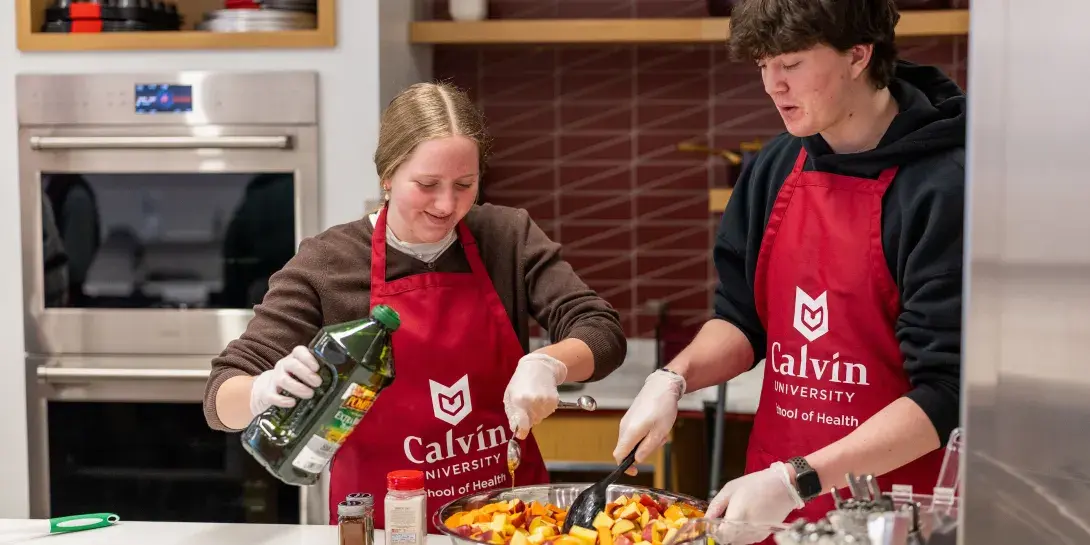
From doctors to physical therapists, nutritionists to chiropractors—healthcare professionals agree that nutrition plays a key role in preventing all kinds of disease.
Calvin University faculty have long had ample expertise to teach students about nutrition. Now, they have a physical space that matches that intellectual reputation. A new donor and grant-funded state-of-the-art Nutrition Lab provides Calvin students with a unique opportunity to see how science can shape healthier lives and communities.
“I’m quite excited for our students. This space provides them with yet another opportunity to connect their brains with their hands,” said Adejoke Ayoola, dean for the School of Health. “I’m confident that our students spending time in this state-of-the-art lab will inspire them and open their minds to other areas of nutrition.”
The lab features a full teaching kitchen with convection ovens, induction cooktops, commercial dishwashing, prep stations, blenders, mixers, and dedicated pantry space. And the state-of-the-art projection system will allow students to follow along with live demonstrations. With a flexible design, it can function as both a kitchen and a 36-seat classroom.
Learning by doing
“In the past, nutrition was mostly a class of just knowledge, but now we are able to give students knowledge and skills—they are learning the content through experiential learning,” said Kerrie Berends, professor of kinesiology.
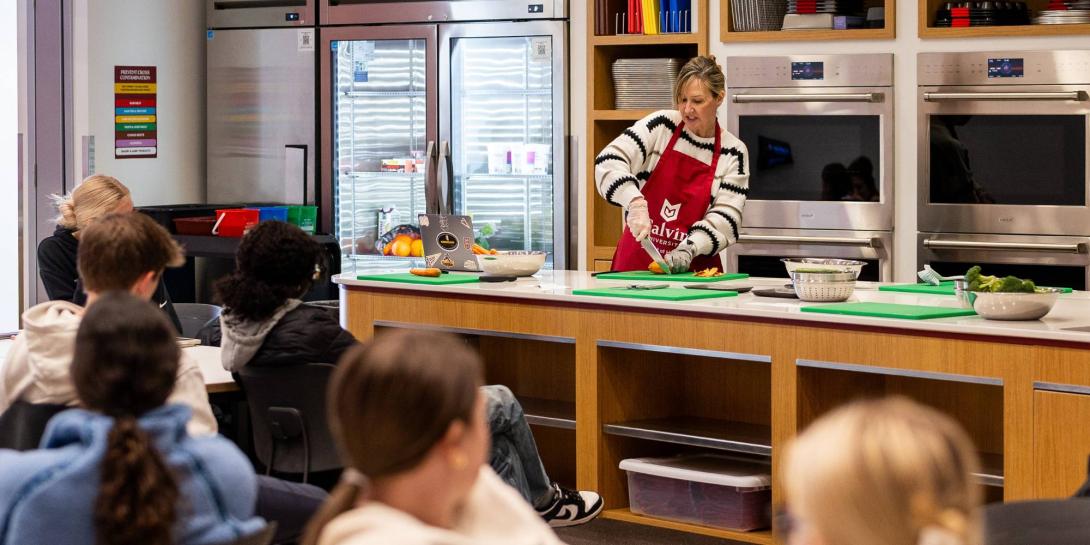
Berends is the first professor to teach in the new lab. She said it’s provided her a blank canvas to redesign a course she’s taught so many times before.
“Student participation and attention have increased from what I’ve experienced in the past. There’s 100% engagement,” said Berends.
“I love the mix of being able to learn more nutritional information from the teachings on Tuesdays and then to visualize what actual good nutrition looks like by putting it into practice with the hands-on lab on Thursdays,” said Sylvie Mulder ’28, a sophomore studying kinesiology on a pre-PT track.
Preparing in industry standard spaces
The Nutrition Lab is just the latest example of Calvin continuing to expand the hands-on learning opportunities for students. Within the past five years, in the School of Health alone, the university has added a cadaver lab, biomechanics and balance lab, exercise bod pod, nursing simulation, and virtual simulation lab to its portfolio.
“We now have industry standard spaces,” said Arlene Hoogewerf, who has a doctorate in nutrition and is dean of natural sciences. “This gives us greater legitimacy and credibility.”
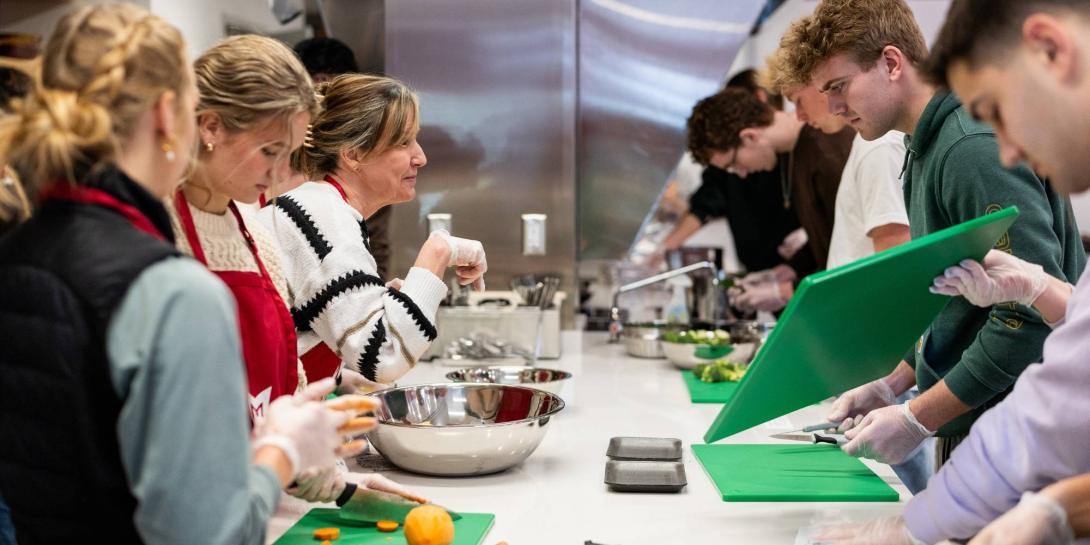
Faculty say the volume of experiential learning opportunities students have on-campus in the School of Health is impressive among its peers and is even comparable to some larger universities.
“When it comes to the major equipment, we have everything anyone else has,” said Berends. “Calvin students who go onto grad school say their first semester was review or that they came in with a leg up because they were familiar with certain equipment whereas it was new for some of their peers from other institutions.”
Learning career and life skills
And while students appreciate how the hands-on learning opportunities they’re gaining in the Nutrition Lab will directly impact their future careers, they also see both the short-term and long-term benefits for all of life.
“This is super applicable for college students. We are learning how to make affordable nutritious meals—understanding how to make affordable options that will fuel our bodies and provide us good nutrition,” said Mulder.
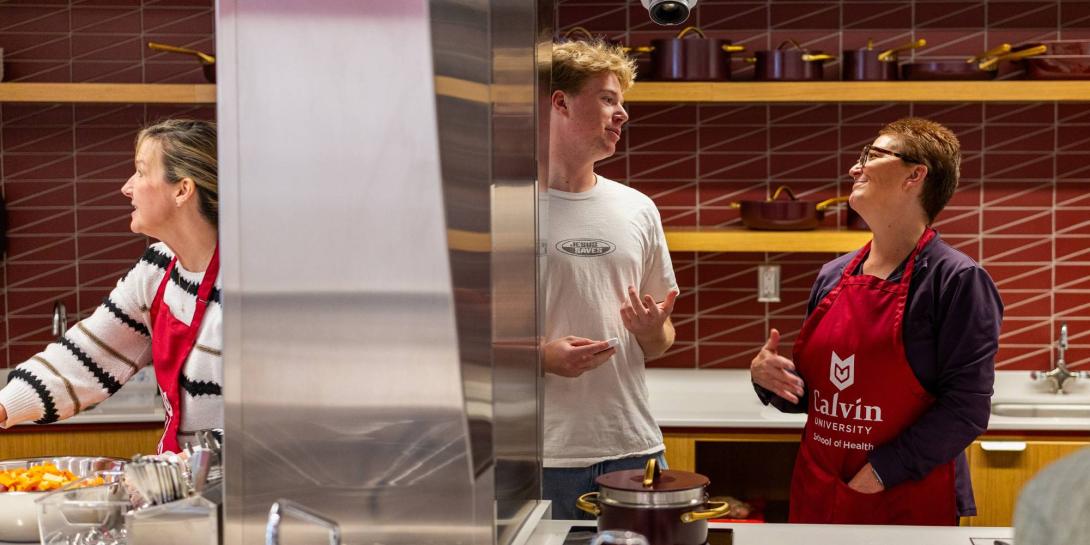
“We’re trying to give them knowledge and skills that have both professional and personal application. Who doesn’t need kitchen skills, better nutritional knowledge—what is organic, how to read a nutritional label, how to cook vegetables so they maintain their maximum nutritional value, how certain foods help with blood sugar regulation,” said Berends. “We are trying to expand what their choices will be in the future.
Opening up additional opportunities
And the university isn’t keeping this gift to themselves. This summer, the space will open up a much more robust learning environment for their Summer H.E.A.L.T.H. Camp, which is a weeklong summer camp for young people from mostly medically underserved communities in Grand Rapids to learn more about their own health and health careers.
“We’ve been offering this camp for a decade now and there’s always been a nutrition component as part of it,” said Hoogewerf. “This new space will provide a much better experience and will allow more hands-on learning opportunities for the participants.”
While the Nutrition Lab is housed in the School of Health, leaders are excited to imagine the various ways academic departments from across campus may use the space for teaching and research and the creative opportunities the space will open up for community engagement.


