Degree Completion Program Offers Step Up for Two Colleagues
Photos by Lisa Hunter
Hannah Ruemmler has always wanted to finish her bachelor’s degree. The problem: She also works full-time as an early childhood educator, which leaves her little flexibility during the day for classes. She felt stuck with limited advancement opportunities in her field and lacked a community that could help her achieve her dream of graduating.
Then she discovered Calvin’s degree completion program.
Her coworkers at the Olivia Haverkamp Early Learning Center shared about the community they’d found during their time at Calvin. Ruemmler wanted a local community like that too. After inquiring, she learned that degree completion classes are offered one evening per week, one class at a time.
“That was ideal,” Ruemmler said. “The hybrid format allows me to allocate my time between work and school and not feel overwhelmed.”
Finding Community and Support
Though Ruemmler was initially nervous to start at Calvin, she feels at ease now.
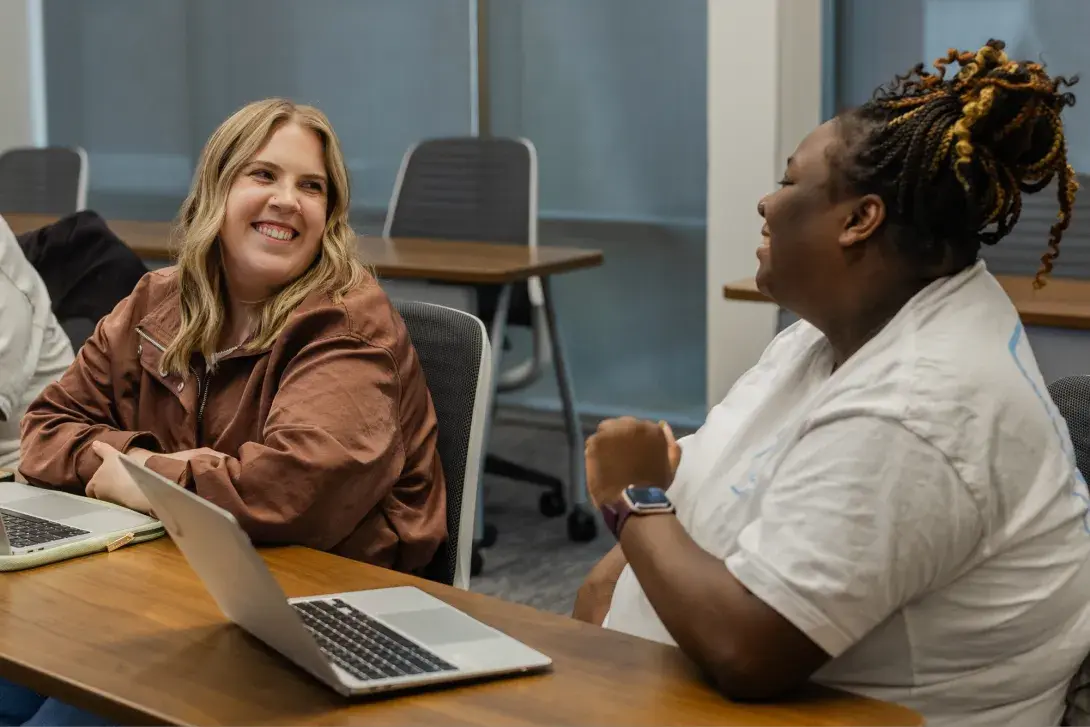
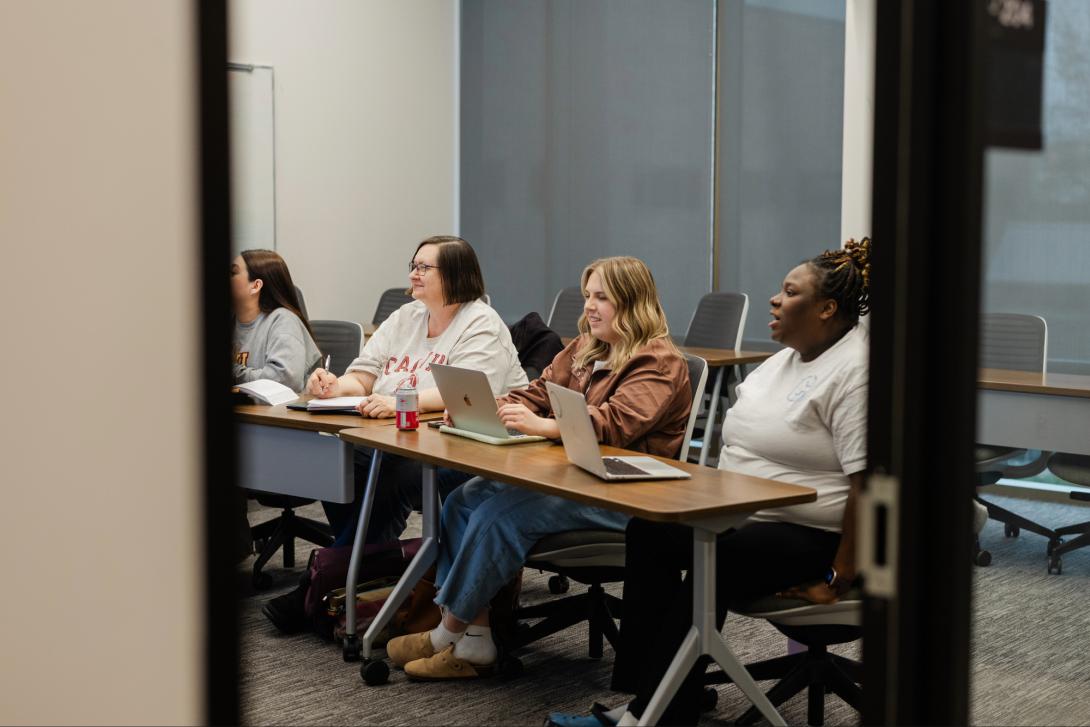
“We all know each other,” she said of her class. “It’s like a big family that meets once a week. . . . This is a program that balances work, life, and school well, all while joining in a community that’s loving and welcoming.”
One of her classmates in the degree completion program is Panecia Howard, a colleague at the Olivia Haverkamp center.
“No one in my family has been to college, and I really wanted to show my nieces and nephews that it is possible to go to college,” Howard said.
Like Ruemmler, Howard chose Calvin because the flexible format allows her to both work and go to school. No other programs she looked at—and there were many—fit this criterion. She appreciates the hybrid format especially. Purely online programs, which she’d tried in the past, meant she lost personal connections with fellow students and professors.
With the understanding that many adult learners juggle work and family, Calvin designed a program that focuses on building support. Howard has found that the staff at Calvin care not only about her schoolwork but her mental and physical health as well.
“Sometimes I’m really nervous and think, I’m doing all this alone. But I’m not alone,” Howard said. “Calvin’s really good at supporting me in any way they can,” she continued, citing the lower cost and the inclusion of things like course materials and bus passes in the tuition.
Like Ruemmler, Howard has found the community with other students to be a crucial component of the program. “We have this group chat now, and we talk, and we try to figure out how to help each other,” Howard said. “I just feel so much support and so many people are there to help me.”
The Benefits of a Bachelor’s Degree
Studies have shown that college graduates tend to earn 37 percent more annually than those without a degree, and, on average, completing a bachelor’s degree adds roughly $1 million or more in lifetime earnings relative to a high school diploma.
Degree completion programs like Calvin’s make the process simple:
- Apply: Meet with an advisor to learn more and create a customized plan. Transfer credits are accepted.
- Follow Your Plan: Courses are offered one at a time, one evening per week (6–9 p.m.) in the fall and spring, and are fully online during the summer.
- Do It Together: Calvin’s program offers built-in support with a dedicated advisor and cohort community. Everything students need is included in the tuition cost (including course materials, books, and bus/parking passes).
- Graduate: Walk across the stage into new opportunities.
But it’s important to note that students like Ruemmler and Howard aren’t just aiming for increased earnings.
Ruemmler says that both her work and studies are vital because she’s preparing future generations. “I need to be pouring into myself just as much as I’m pouring into little lives,” she said. “Learning new things reenergizes me to go support my students well.”
With degree in hand, Ruemmler hopes to lead bigger conversations about change in early childhood education. “This one step—one big step—is going to open doors for me.”
As the first in her family to graduate soon from college, Howard also hopes to become a leader in her field who can help people see the value of early childhood education—and of college education.
“Anyone is able to go to college,” Howard said. “No matter how you look, no matter who you are.”
If you’re interested in learning more about Calvin’s degree completion program, fill out an interest form to talk to an advisor. This might be the opportunity you’ve been waiting for to advance in your field like Ruemmler or be a first-generation role model like Howard—all with a supportive community journeying alongside you.