From Classroom to Career: How Experiential Learning Shaped Sofie Schumerth’s Engineering Path
When Sofie Schumerth ’26 graduates this May, she’ll walk away with an engineering degree and a clear next step. Just weeks later, she’ll move to Denver, Colorado, to launch her career with Muller Engineering Company.
“If you told me four years ago this is where I’d be, I would have thought it sounded like a dream,” said Schumerth. “I wouldn’t have known how it was going to happen.”
The path Schumerth started on in the fall of 2022 would make this destination possible. From Appleton, Wisconsin, she had applied to four Midwest schools. A rigorous engineering education and the opportunity to run cross country were of utmost importance in her selection. A strong scholarship package and a standout campus visit helped make the decision clear. She chose Calvin University.
Discovering engineering as a way to serve
From her first engineering class, Schumerth sensed she was in the right place. While she had always loved math, hands-on problem solving, and designing solutions, Calvin’s Engineering 101 course reframed her understanding of what engineering could be.
“Engineering 101 was the first time that I started thinking of engineering as a service profession, and that made it more exciting to me,” said Schumerth. “I could really see myself diving into the mathematical component and also being able to help people.”
For Schumerth that is where the seeds got initially planted. Over the next few years, she’s seen how those seeds have blossomed.
Learning by doing, guided by faculty
As Schumerth progressed through the engineering program, she was exposed to all major concentrations. She said that breadth helped her build a strong knowledge base while she discerned where her interests and skills aligned best.
A turning point for her came in her hydraulics courses taught by Professor Wildschut.
“She is really passionate about stormwater,” said Schumerth. “Seeing her passion come through made me realize that this is the kind of work that I want to go into—building a career path towards stormwater management and floodplain remediation. Those courses kind of put me on that path.”
While her professors instilled passion, they also helped solidify concepts through hands-on learning experiences. Early courses reinforced concepts through labs, while upper-level classes became increasingly project-based with students being asked to solve complex, real-world problems using what they had learned.
Connected to opportunities beyond the classroom
While Schumerth’s professors integrated experiential learning opportunities into the regular coursework cadence, they also connected her to many opportunities beyond the classroom.
Schumerth studied engineering abroad in Germany after her first year, conducted research during her sophomore year (with a paper currently under review by a major journal), and completed an internship in her field this past summer (which has led to continued part-time work during her final year at Calvin).
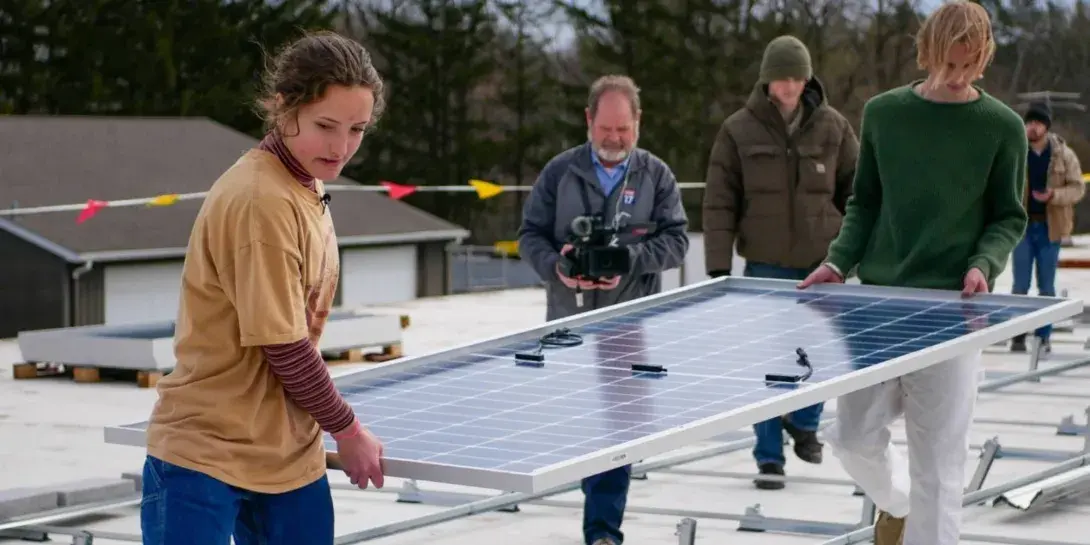
She also served as an intern with the Calvin Energy Recovery Fund, where she helped install a solar array on campus and contributed to efficiency upgrades to university facilities.
Perhaps most impactful was the professional connection that shaped her post-graduation plans.
“Professor Wildschut connected me with a Calvin alum, who then connected me with their company,” said Schumerth. “That’s how I ended up with the position I’m starting this summer.”
Graduating with more than a degree
As Schumerth prepares to head out west to begin her career, she leaves Calvin with far more than technical knowledge in her field.
She leaves with friendships formed through cross country and her major, a love for the outdoors cultivated through outdoor recreation opportunities, and enduring relationships with professors who became mentors, advocates, and friends.
Schumerth’s story reflects a broader truth about engineering education at Calvin: when rigorous academics are paired with experiential learning, faculty mentorship, and real‑world opportunities, students graduate both ready to serve and lead.


