Choosing Calvin: How Clara Parker found a bigger vision for her life
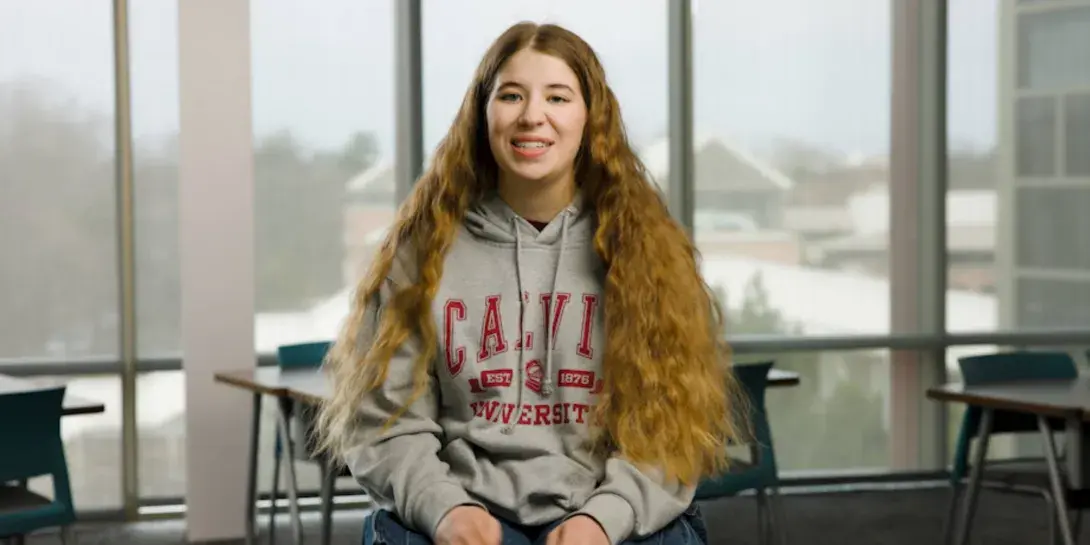
When Clara Parker ’28 was deciding what to do after high school, her choice came down to two colleges: one just miles from her home in Alabama, and another nearly 800 miles north. Both offered similar financial aid. On paper, either path made sense.
What Parker, who was ready to pursue an education major, didn’t know yet was how much the right community could expand her sense of what was possible.
“I was hoping to get my degree and maybe make a few friends,” Parker said of her expectations for college. “Had I chosen a different school, I likely would have been happy,” said Parker. “But I would not have encountered the same breadth of opportunity, mentorship, or community. Calvin helped me understand what is possible for my life.”
An expanded vision for college
As she weighed her options, Parker knew she wanted to be part of a campus where faith was lived out. Weekly chapel opportunities mattered to her, as did Calvin’s international student population.
“I wanted to be part of a community that worshipped together,” said Parker. “Living in a community with such diverse voices allows you to gain so many more perspectives, which really shapes the way you think about the world.”
That desire of belonging to a community shaped by worship, diversity, and shared purpose ultimately led her to Calvin.
A broadened and deepened perspective
Once on campus, Parker quickly discovered that her perspective of the world would broaden and deepen through experiences outside the classroom.
“I’ve been blessed to be part of something called the 7:9 Project, which is a multicultural worship group. It’s a space where not just international students, but students from right here in Michigan can come together and worship in lots of different languages,” said Parker. “It reflects the vision in Revelation 7:9—every tribe, tongue, and nation worshipping together.”
Parker says that is just one example of a community where so many voices are heard. Today, she serves as a worship apprentice, helping plan and lead chapel services that reflect a wide range of cultural traditions.
“It’s always an incredible experience to see how many different ways we can worship God, and how that expands your sense of how big God truly is,” said Parker.
An unexpected turn
Parker’s world and vision for her future expanded inside the classroom as well—sometimes in unexpected ways. A randomly assigned philosophy of disability course introduced her to disability advocacy, a field she had never encountered before.
“It changed my entire life trajectory,” she said.
Originally an elementary education major, Parker transitioned to special education after the course helped her recognize how deeply ableism is embedded in society.
“Learning about how prevalent ableism is in society—often in ways I hadn’t even recognized—shifted my perspective,” she said. “Grounding that learning in the belief that every human is inherently valuable because we are created in God’s image provided a holistic understanding of how society should view disability.”
At Calvin, Parker was discovering that her faith was not confined to chapel, but woven throughout her academic experience.
“It makes learning more meaningful when you can tie it back to your faith,” she said.
The intersection of passions
Parker has also discovered how her academic interests intersect with her creative pursuits. She is currently working as part of the production team on Calvin’s musical Bye Bye Birdie, where the lead character is being portrayed by someone who is Deaf/ Hard-of-Hearing.
“That experience has taught me so much about deaf culture and about what authentic representation should look like in the performing arts,” said Parker.
Each of these experiences has helped Parker imagine a future that is both integrated and expansive.
“The liberal arts experience has opened my mind to possibilities I didn’t even know existed,” said Parker. “Instead of being an educator, I can be an educator who counsels, works with IEPs (individualized education plans), participates in theater, and advocates for students. Those intersections are powerful.”
Equipped for her future
As she looks to the future, Parker is considering whether to get a license in clinical social work or a master’s in theater education, with the ultimate goal of pursuing disability advocacy as a full-time career.
“I feel well-equipped by Calvin to pursue either path,” she said. “No matter what, I hope to continue being involved in theater and education, advocating for students and supporting their needs.”


