Calvin’s speech-language pathology program sets students up for success—and purpose
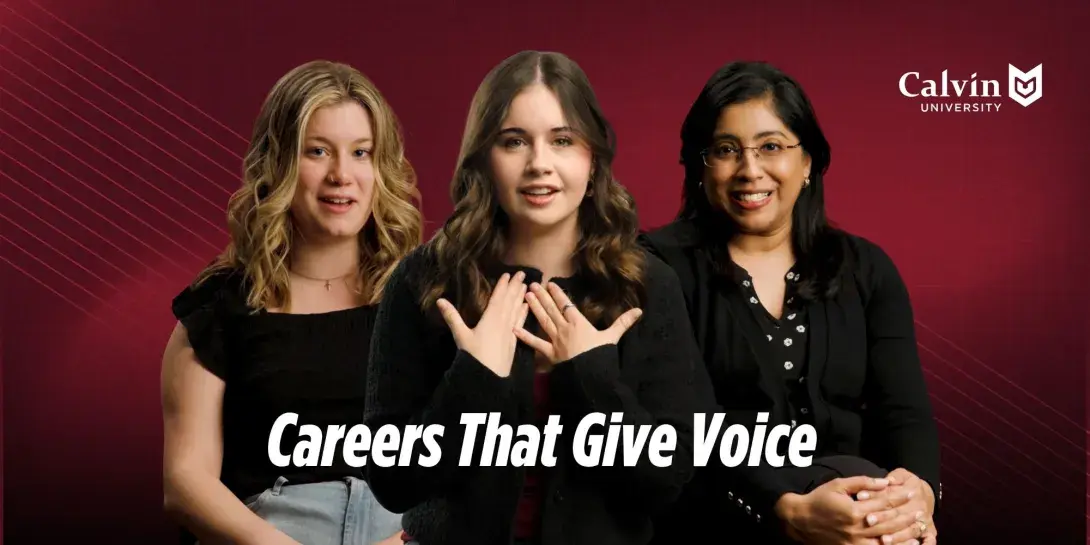
Kiah Heminghaus thought she wanted to be a pediatrician growing up. But one day when she was nannying, a family friend asked if she had ever heard of speech-language pathology. She looked it up that night, was immediately hooked, and booked a visit to Calvin to explore the program the following week.
Heminghaus went on to enroll in Calvin’s five-year combined BA/MA program, which includes a three-year bachelor’s and a two-year master’s in speech-language pathology.
Now completing her master’s, she joins a growing number of students interested in becoming a speech pathologist—a career with an excellent job outlook (15% growth by 2034), strong earning potential, and solid long-term stability across a variety of settings.
As she looks to graduate soon, she’s found that Calvin’s program in particular has set her up for a fulfilling career.
The ‘aha’ moment
Rebecca Farrell, an undergraduate student enrolled in the five-year program like Heminghaus, didn’t consider herself a science person. So she was surprised to discover how much she enjoyed her anatomy class, where she learned that speaking is “one of the most complex physiological and neurological processes that our body can do.”
“I’ve been really reinforced in my degree choice by that class,” she noted. “Even though it’s hard sometimes, it’s really fun, and we all support each other, and it’s definitely a community.”
Beth Oommen, one of the professors in the speech pathology and audiology department and the undergraduate program director, shares in the excitement over what can happen inside the classroom. That ‘aha’ moment that Farrell experienced is a key part of Oommen’s pedagogy.
“It’s not just about knowing the diagnosis or the steps to implement. It’s understanding the ‘why’ behind what they’re doing. It’s something that I incorporate in all my courses. ‘Do you know why?’—I always ask that to students,” she said.
Professors like Oommen are a key reason that Calvin has a nearly 100% pass rate for the PRAXIS exam, the national licensure and certification test required to practice as a speech-language pathologist. Calvin’s program is also rated A+ on the 2026 best SLP master’s programs list.
“Yes, it’s going to be rigorous. Yes, it’s going to be hard,” Oommen said. “It’s going to stretch your limits in many aspects, but that’s a good thing. Because we are walking together.”
Hands-on experience
Oommen understands that there are many things students need to learn during their time at Calvin in order to grow in confidence, skills, and experience—and that this also means going beyond the classroom.
“In our field, students or graduates are working with individuals’ lives. Decisions they make have a direct impact on a person’s health,” she said. “So being vulnerable, being honest, making mistakes is an important part of learning, because we tend to remember and learn from those moments a lot more.”
One of the ways the master’s program offers hands-on experience is through having students work with clients in Calvin’s on-campus clinic. The clinic work continues for the first three semesters of the graduate program, and then each student is assigned an externship.
Heminghaus was placed in a public school doing bilingual speech therapy, where she evaluated children in both Spanish and English through assessments, learned how to lead an IEP (individualized education plan) meeting, and educated teachers on incorporating special devices in their classrooms.
“I used to be really worried about being prepared to take on a whole caseload and to be ready upon graduation to go out into the workforce,” she said. “With our externships and classes here at Calvin, I feel very prepared for that.”
Preparing to launch
Speech pathology and audiology is a diverse field, with practitioners working in hospitals, schools, offices, residential care facilities, and other settings.
After graduation, Heminghaus plans to be a pediatric speech-language pathologist, either in a school where she can use her Spanish skills or in an inpatient office.
“I am very excited to step into the world as a licensed speech-language pathologist,” she said. “I am excited to help empower kids to be able to communicate.”
Farrell, on the other hand, is particularly drawn to working in prison systems.
“A lot of juveniles and other prisoners have issues with communication and have not been given the resources that they need to be able to beat those battles, and to stand up for themselves in a court of law or in other situations,” she said.
“I definitely feel pulled toward those people, because a lot of times they’re left behind in our system. I feel passionate about wanting to give them a voice.”
“Without speech, we can’t have community,” Farrell added. “And without communication, we can’t educate ourselves. All of that is very interconnected and important.”
Interested in Calvin’s Speech-Language Pathology programs? Learn more or reach out to us for more information. You can also explore Calvin’s other undergraduate and graduate programs.