Calvin University launches School of Engineering and Computer Science to prepare technology leaders for the future
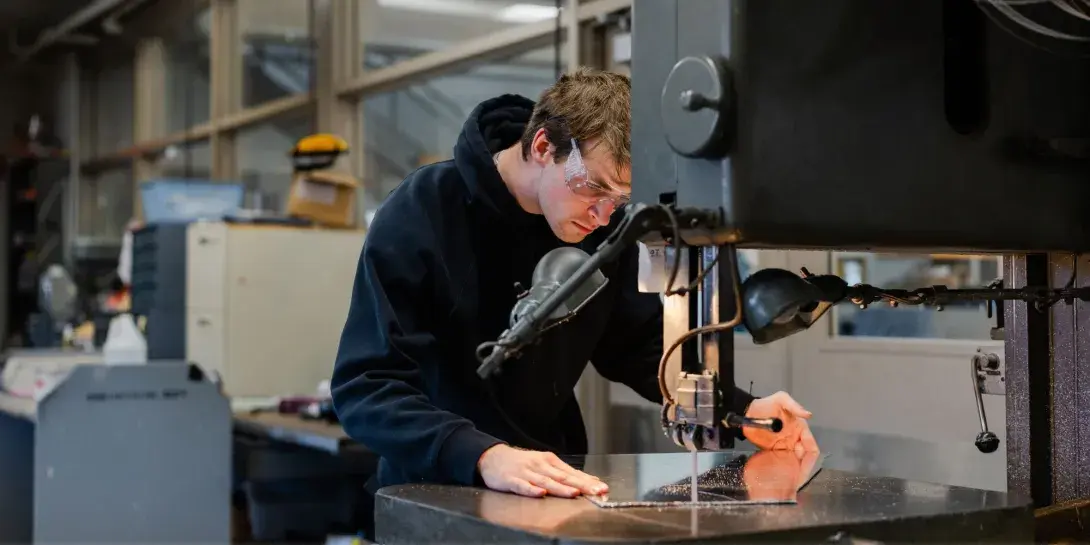
The technologies shaping the future are advancing at an extraordinary pace. Artificial intelligence, automation, cybersecurity, aerospace, advanced computing and other emerging technologies are changing how people live, work, and solve some of the world's most complex problems.
Calvin University believes the people designing those technologies need more than technical expertise.
They need wisdom. They need creativity. They need the ability to understand the human consequences of their work. And they need a sense of responsibility for how their innovations will serve people and communities.
That vision is at the heart of Calvin's new School of Engineering and Computer Science, which brings together the university's long-established engineering and computer science programs under a unified vision for the future.
The launch builds on decades of academic excellence while positioning Calvin to expand its impact in fields increasingly shaped by technology.
“Technology is transforming our world at an unprecedented pace,” said Greg Elzinga, president of Calvin University. “The future requires more than brilliant engineers and computer scientists. It requires leaders who will design, develop, and advance technologies with wisdom, integrity, and a deep sense of responsibility.”
At Calvin, that preparation begins with rigorous technical education but extends beyond the classroom.
Students in the new school will continue to study the fundamentals of engineering and computing while engaging with the broader questions surrounding technological innovation: How can technology improve lives? How do we innovate responsibly? And how can the solutions we create contribute to human flourishing?
“Technology is not simply about what we can build,” said Kevin den Dulk, interim provost at Calvin. “Our students are challenged to ask the questions that matter. How can technology improve lives? How do we innovate responsibly? How do we design solutions that contribute to human flourishing? Those questions define the Calvin difference.”
Building on decades of experience
The new school is not a starting point for Calvin's engineering and computer science education. It is an investment in programs that have been developing for decades.
Calvin's engineering program has held ABET accreditation for decades and was among the earliest accredited engineering programs in Christian higher education. Its computer science program is also ABET accredited, preparing graduates for careers and advanced study in a field that continues to evolve rapidly.
The new school gives those programs a stronger collective identity while creating a platform for future growth.
Current engineering concentrations include aerospace, chemical, civil and environmental, electrical and computer, energy/environment/sustainability, mechanical, and mechatronics engineering. Computer science students likewise prepare for careers across a growing range of computing and technology fields.
Looking ahead, Calvin plans to strengthen its offerings in areas including resilient infrastructure, advanced energy systems, biotechnology, automated systems, artificial intelligence, advanced computing, and cybersecurity.
The school also will pursue expanded partnerships with industry, undergraduate research, experiential learning, and opportunities for graduate education.
Preparing students for more than a first job
For Calvin students, the new school is ultimately about more than adding programs or creating a new academic structure.
It is about preparing them for careers that may not even exist yet.
Students will have opportunities to work alongside faculty, participate in research, complete internships, and gain hands-on experience through industry connections. At the same time, Calvin's liberal arts curriculum and Christian perspective will challenge students to consider the broader implications of the technologies they are developing.
That combination is increasingly important as technology becomes woven into virtually every part of society.
An artificial intelligence system, for example, is not simply a technical achievement. It can influence employment, education, privacy, human relationships and decision-making. A new infrastructure system can affect communities for generations. Advances in biotechnology can create extraordinary possibilities while raising difficult ethical questions.
Calvin's approach asks students to engage those questions alongside the technical ones.
“The goal is not simply to prepare students to develop and build technology,” Elzinga said. “At Calvin, we prepare students to build technology that improves lives, serves others, and honors God.”
That approach reflects Calvin's broader mission of equipping students to think deeply, act justly, and live wholeheartedly as Christ's agents of renewal in the world.
A growing opportunity for Calvin and its graduates
The launch comes at a time when demand continues to grow for professionals with expertise in engineering and computing. Software, automation, robotics, aerospace, cybersecurity, data science, and artificial intelligence are reshaping industries and creating new opportunities for graduates.
Calvin sees an opportunity to prepare students to enter those fields with both competence and conviction.
For employers, that means graduates who bring technical expertise alongside communication skills, creativity, adaptability, and ethical leadership.
For students, it means access to a growing network of faculty, industry partners, research experiences, and opportunities to apply what they learn to real-world challenges.
And for Calvin, it represents an opportunity to build on decades of engineering and computer science education while preparing a new generation of leaders for a rapidly changing technological landscape.
“Technology will continue to change,” Elzinga said. “But our commitment to preparing students who use their gifts to serve others will not.”
The School of Engineering and Computer Science represents Calvin's vision for what that preparation can look like: technical excellence grounded in the liberal arts, shaped by Christian faith, and directed toward the flourishing of people and the world.


