Calvin Remembers Richard Wevers
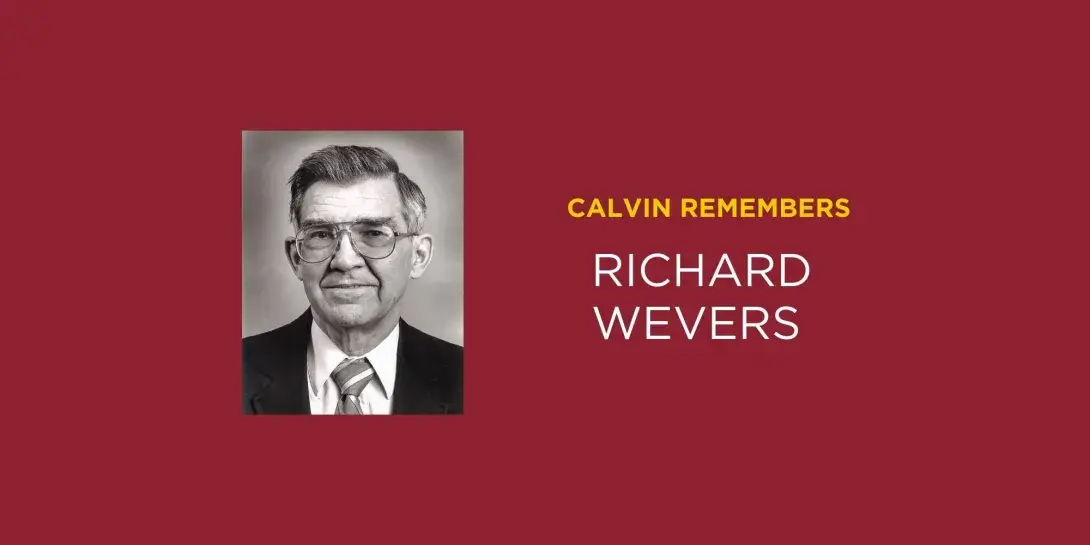
At Calvin, Richard Wevers kept a close eye on the text and the time. For 35 years, he made sure to equip his students in classical languages to accurately interpret Greek texts. And for 25 of those years, he served as the timer for men’s basketball games.
On January 21, 2026, Wevers passed away peacefully at Faith Hospice Trillium Woods. He was 92 years old.
Modeling humility and reverence
Wevers’ desire to be precise when it came to teaching Greek and Latin texts to predominantly pre-seminary students came from a reverence for the text and a basic humility before it.
“He was kind, clear, and had an obvious love of the text,” said Mary Hulst, a former student of Wevers and now university pastor.
“He taught his students to respect the text and think carefully about its meaning for our lives,” said Ken Bratt, who had Wevers as a professor at Calvin in the 1960s and later served alongside him in the Classics department for many years. During part of that time, Wevers served as department chair.
Exploring new terrain
Wevers thought deeply about the ancient world, but he also was an innovator at Calvin. In fact, Wevers was instrumental in bringing Calvin into the digital age.
Before coming to Calvin, after earning his doctorate degree in classical languages from the University of Wisconsin, Wevers began using computers to study Greek texts. To try to discover authorship of the text, the computer would compare its stylistic traits to another writing—just much faster than a human with hard copies could.
Before 1970, Calvin was only using computers for payroll and class lists. But by the turn of the decade, Wevers entered uncharted territory, teaching the first computer science class at Calvin: programming in FORTRAN.
Putting others first
While Wevers used computers to help in his own scholarship and ongoing learning, he was most concerned with how this newer technology could help others, mainly students and other scholars.
“Rich was always interested in creating computer drills that would help students learn Greek and Latin and search programs that helped scholars analyze Greek and Latin texts,” said Bratt.
Leaving layers of legacy
And the foundations he laid are central to his ongoing legacy.
“He’s equipped a generation of future pastors with skills for interpreting the Greek text of the New Testament. He’s also built a record of outstanding computerized reference works on John Calvin’s Latin Bible and two editions of Calvin’s Institutes.”
His legacy will also live on through a named scholarship he and his wife Sylvia set up in their name and through a regular gathering of retirees for which he was a founding member. Wevers was the last surviving member from the original group of retirees.
“In his retirement years his kindness continued,” recalls Hulst. “He was part of the ‘emeritorium’ that met every morning for coffee, and we would pass in the hall almost daily. He always greeted me with a warm smile and a kind comment.”
And even as he struggled with dementia in recent years, his precision and love for languages remained steadfast as he could still recite the Lord’s Prayer in both Latin and Dutch and would read from the Greek Bible.
Wevers is survived by his wife of 69 years Sylvia, and three of their children: Jan (Dick) Wilkins, June (Dale) Bloem, and Jackie (Jim) Henderson, eight grandchildren, and 12 great-grandchildren. He was preceded in death by his daughter Judy (Dan) Bode.