Building a Better Tomorrow
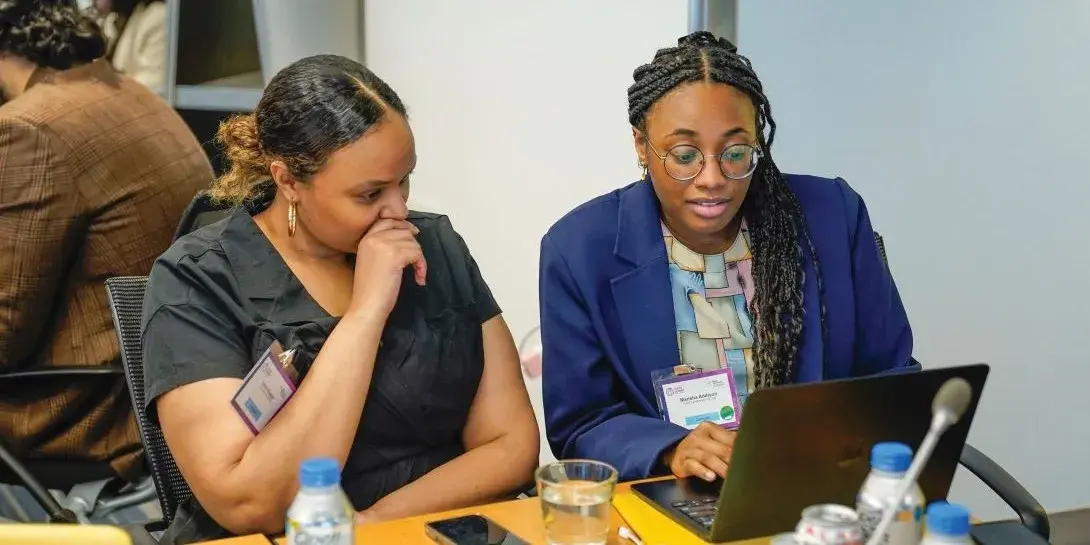
“My journey to Calvin College was really unexpected, but in the best way,” Entrada Scholar Marisha Addison ’18 says. Addison first learned about Entrada Scholars through a friend of a friend. As a participant, she enjoyed challenging academics and a close-knit community of peers.
Yet when it came time to select a college, Calvin was not her first choice. Then she changed her mind; a phone call to admissions secured her spot. “Looking back, I’m so glad I made that call,” she says.
Addison had dreamed of becoming a film director but spent the next four years pursuing an academic path that better aligned with her passion for history, geography, and untold stories. In January 2017, she traveled to Ethiopia for a three-week course about the challenges of access to clean water.
“My first study abroad in Ethiopia was especially formative. It was led by Professor Johnathan Bascom—my advisor, mentor, and Calvin abba—who modeled what it meant to do research well. Our role is not to arrive as saviors or assume we know everything, but to listen, learn, and collaborate with local communities,” Addison says.
Now a doctoral candidate at the University of Maryland, Addison holds a deep commitment to understanding and partnering with the people her work impacts. Her dissertation research focuses on the journey to school, a universal activity for over a billion students worldwide. “This journey is deeply unequal and is plagued with risks,” says Addison, who cites motor vehicle accidents as a leading cause of death for students aged 5 to 29 traveling between home and school. “Despite this, transportation and infrastructure have been largely overlooked in education and development research. By highlighting these intersections, my goal is to contribute to building not just better schools or policies, but better todays and tomorrows for young people.”
In May 2025, Addison was selected as a delegate for the World Bank Youth Summit’s Innovation Lab, an event that gathers thousands of young leaders from across the globe to address the most pressing issues of their generation.
Addison worked with a team to better understand food insecurity and its relationship to inadequate infrastructure and transportation in Ethiopia. The group was tasked with designing a “geospatial, data-driven strategy for food security and infrastructure planning.” They tapped into local resources and existing location-based data to guide recommendations about where and how investments should be made.
“It was a true full-circle moment—connecting my scholarly interests with a real-world challenge in a country that shaped my academic journey from the very beginning.”