Always Reforming
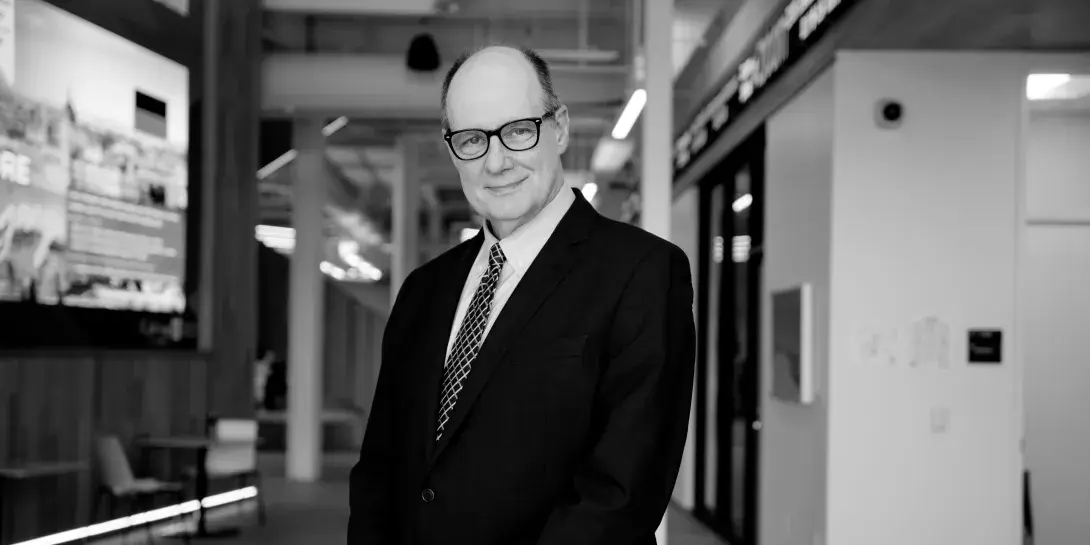
John Witte Jr. '82
Legal historian Dr. John Witte, Jr. ’82 has conducted ground-breaking work in the study of law and religion, mentored the next generation of scholars in his field, and shaped academic discourse worldwide. A graduate of Harvard Law School, he holds three distinguished titles at Emory University, where he has taught since 1985: Woodruff University Professor of Law, McDonald Distinguished Professor of Religion, and Faculty Director of the Center for the Study of Law and Religion.
Legal historians study the development of legal ideas and institutions. Witte’s scholarship focuses on the fundamental questions of “faith, freedom, and family from antiquity until today.”
He believes religion and law are not just systems or institutions—they’re tools for navigating human complexity and enabling shared understanding. “Religion and law are among the universal solvents of human living. They’re fundamental to our existence as persons and peoples,” he says. “The need to study them responsibly is critical.”
Master Scholar and Teacher
Witte views his vocation as a way of living out his faith. Over the last four decades, he has directed 20 major international projects involving 1600 scholars worldwide on the topics of law and Christianity; democracy, human rights, and religious liberty; and marriage, family, and children. He has been inducted into the American Academy of Arts & Sciences and the Royal Academy of Jurisprudence and Legislation in Spain.
Witte is also a prolific writer and accomplished editor. In addition to editing a number of scholarly journals and book series, he has published 350 articles, 19 journal symposia, and 45 books.
His intellect and voice are far-reaching, yet he is also a master teacher. Among his many awards and prizes for teaching and research, Witte has been named 12 times by Emory law students as Most Outstanding Professor.
“I love teaching,” Witte says. “It’s an opportunity to shape the next generation of leadership in church, state, and society.”
As a Calvin undergraduate, he studied biology, history, and philosophy. He fondly recalls the mentorship he received and the way his professors helped shape his thinking through a Reformed lens.
Interfaith Conversations
A self-described “old-fashioned Protestant,” Witte says his continued drive and curiosity come from a deep commitment to vocation, collegiality, and finding ways of “making common cause across religious, political, social, and cultural differences.”
Guided by the Reformed ethic ecclesia reformata, semper reformanda —“the church reformed, always reforming”—Witte believes that engaging other faith traditions illuminates one’s own.
“My deep Christian faith empowers me to appreciate those who have different faith claims, starting points, and premises for their work. Ideas like natural law, common grace, or general revelation force us to appreciate that everyone—Jew, Muslim, Christian—is wrestling with the most fundamental questions. Finding ways of living together as people of different faiths and perspectives is one of the goals of the projects I’m involved in.”
Witte notes a dramatic shift in global discourse on human rights and religious liberty since the “grand idealism” of the post-WWII era. Putting those ideals into practice has proved difficult, and, in today’s global political climate, they’re also increasingly fragile.
“When authoritarian regimes rise, human rights commitments become more present on paper than in practice,” he warns. “It has never been more important to explore the deep religious sources and dimensions of human rights and religious freedom.”
Open Mind, Open Heart
Lifting up dimensions of religion and the law at a secular university presents a unique challenge, however. “The lectern is not a pulpit, but in the privacy of my office or in conversations with students, I feel fully liberated to discuss what faith means to me,” Witte says.
He has advice for Calvin’s current undergraduates, too: “Study hard. Read voraciously. Don’t specialize too quickly. Find mentors who can guide you. Find conversation partners who will keep you honest and push you forward.”
“Be open to new understandings of the faith, inspired by new experiences, the Holy Spirit, and others of comparable faith.”
“Always be open to reform.”
Enjoy John Witte Jr.'s 2025 Distinguished Alumni Award winner video on Calvin University's YouTube channel.