Calvin hosts a film screening that turns debate into dialogue
According to a recent Gallup poll, a record 80% of U.S. adults believe the country is deeply divided on key values.
What’s more, a study out of Brown University found that affective polarization—the phenomenon where individuals in opposing political parties increasingly distrust and display negative emotions toward one another, while favoring their own party—has increased more dramatically in the U.S. over the past 50 years compared to other major democracies.
While access to information is at an all-time high, various forms of media are using algorithms to keep people stuck in echo chambers, where their opinions are confirmed over and over and over again.
Not settling for the status quo
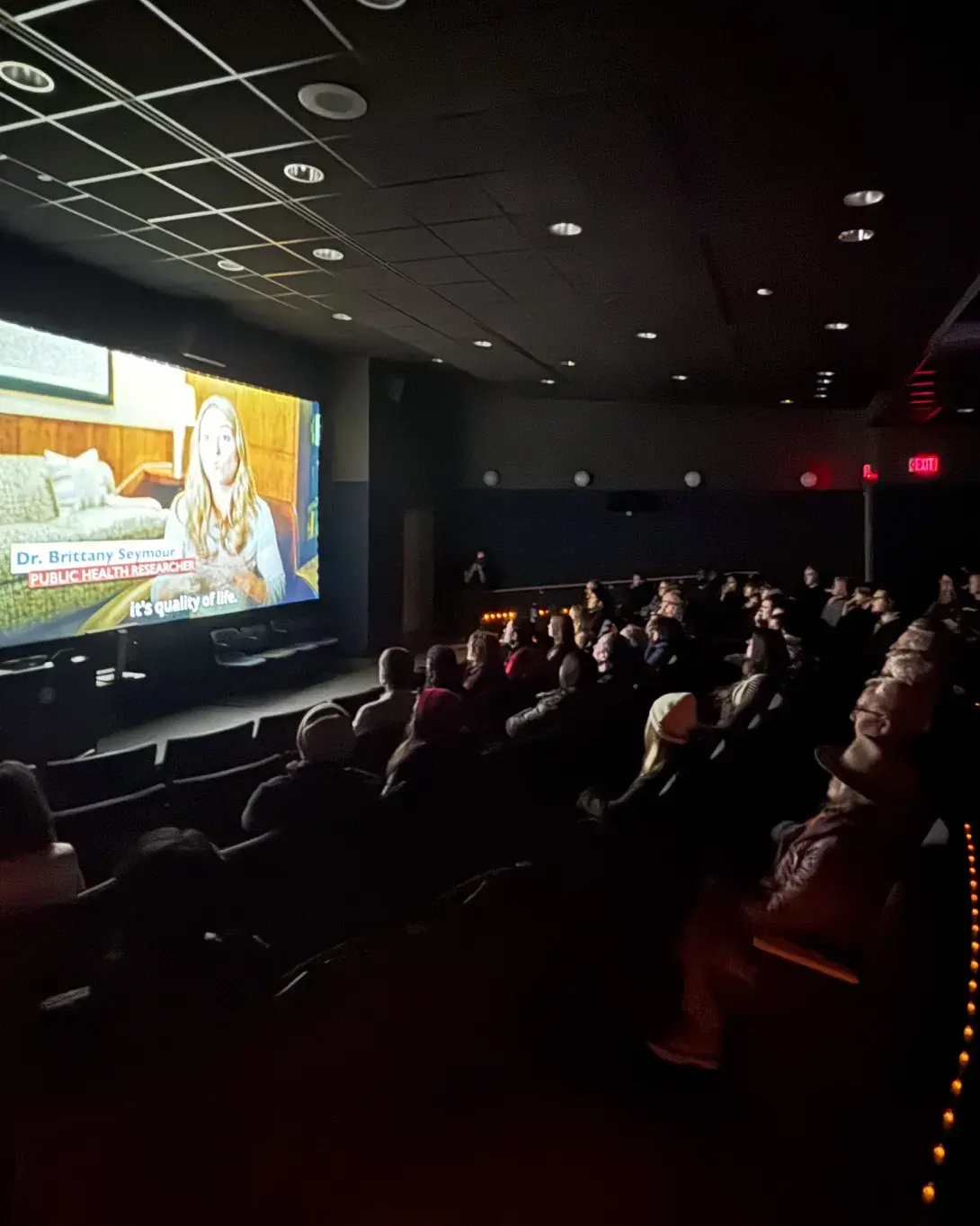
Calvin University faculty aren’t willing to settle for this current reality. On Monday, February 9 at 7 p.m. in the DeVos Communication Center’s Bytwerk Theater, Calvin hosted the Midwest premiere of Dysmocracy: the Fight over Fluoride, a documentary which uses the story of a small Washington town’s battle over water fluoridation to spark a discussion about the nature of democracy and how to make decisions in divided communities.
“The idea of hosting this screening emerged out of a faculty reading group last semester on polarization, populism, and pluralism,” said Sam Smartt, an associate professor of film and media at Calvin University. “The event is really unique because the audience gets polled both before and during the film on whether their opinion on the issue is changing.”
What the film’s director Jordan Melograna and producer Christa Hillstrom have found is that between 30 and 50 percent of the audience will change their minds at least once during the film.
Low stakes, big lessons
“The issue of fluoridation is an excellent mechanism for discussing political division because it doesn’t map across partisan divides and it’s somewhat lower stakes than most hot-button issues,” said Smartt. “So, viewers are able to see their perspectives and the perspectives of others in the room change multiple times and then reflect on the process of decision-making and how to do this well.”
Through events like this, Calvin faculty are hoping to facilitate healthy dialogue.
“We’ve forgotten how to have dialogue across difference,” said Smartt. “We have to learn how to have conversations again.”
Broadening perspectives, deepening convictions
It's a reason Calvin faculty are committed to equipping students to do just that. Smartt said the sole purpose of dialogue around difficult topics isn’t to change people’s minds but rather expand their understanding.
“Your convictions are made stronger, and they are refined by understanding opposing viewpoints,” said Smartt. “Changing minds isn’t the sole purpose of dialogue. We want to teach students to inhabit their beliefs using all the tools God has given us to do that—our minds, our bodies, our relationships. Facilitating this at Calvin is really important.”
The screening was co-sponsored by the Henry Institute and the Calvin Center for Christian Scholarship.